 Deutsch
 English
 Español

Mallorca Property Prices by Area: A Buyer’s Guide to the Island’s Zones
09 Sep 2026 | By Iris Grünewald
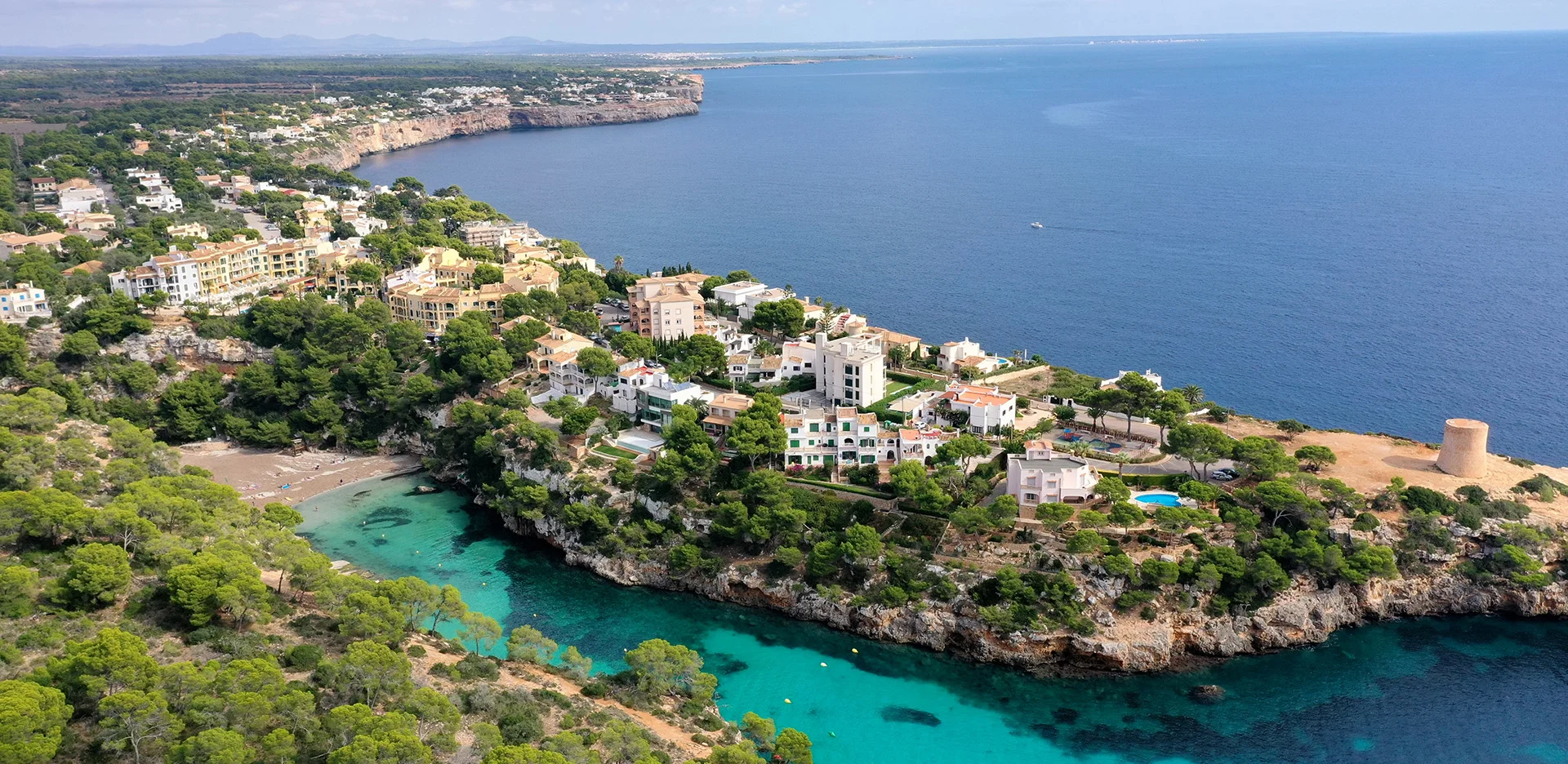
Area guides and price comparisons across Mallorca’s most distinctive regions
Market sources checked: 18 September 2026. Asking-price data, official price indices and completed transactions are different measures and are identified separately. The Balearic Government’s Housing Observatory reported on 17 September 2026 that advertised offers across the islands were around 38% above actual transaction prices, so portal €/m² figures should be used for relative market positioning rather than treated as achieved sale values.
Mallorca is not a single property market, whatever average price gets quoted for the island as a whole. Spain’s National Statistics Institute (INE) recorded a 13.7% year-on-year rise in Balearic housing prices in the second quarter of 2026, the eighth-largest increase of any region in the country and well above the 12.2% national figure. Idealista’s own portal data put the Balearics ahead of every other Spanish region at the start of the year, at roughly €5,194 per square metre for second-hand housing, ahead of Madrid. Those headline numbers are useful for context, but they hide enormous variation across Mallorca itself: a buyer looking in Inca is in a completely different market from one looking in Puerto Andratx, sometimes at less than half the price per square metre.
This guide breaks the island down by area: what each zone actually offers, who tends to buy there, and how the prices compare once the headline figure is set aside.
Explore Mallorca by Area
Use our local area guides to move from market data to the realities of each location: North Mallorca, Northwest Mallorca, Southwest Mallorca, Palma, Central Mallorca, East Mallorca, Southeast Mallorca and South Mallorca. Each guide includes local lifestyle context and Iris Grünewald’s expert perspective on what buyers should consider.
The Southwest: Andratx and Calvià
The southwest corner, running from Andratx and its harbour at Puerto Andratx through to Calvià, Santa Ponsa and Puerto Portals, remains Mallorca’s most expensive stretch of coastline by some distance. This is where large villas with sea views and private pools cluster, many owned by international buyers who use them for a few months a year. Puerto Andratx in particular has built a reputation as one of the more exclusive addresses on the island, its marina drawing a similar crowd to Port de Sóller but on a larger scale. Santa Ponsa and the wider Calvià municipality mix long-established international communities with newer development, and the area’s easy access to Palma’s airport keeps demand steady even when the broader Spanish market cools. Puerto Portals adds a further layer to this: its marina was built around superyacht traffic rather than family sailing, and the restaurants, boutiques and property that surround it are priced with that clientele in mind.
Palma and Son Vida
Palma itself works almost as a market of its own. The Old Town has drawn a wave of renovation buyers over the past decade, converting historic townhouses into high-spec homes within walking distance of the cathedral and the port. Santa Catalina and Portixol, just outside the old walls, have followed a similar path with a younger, more design-led crowd. On the hill above the city, Son Vida is a different proposition again: gated, golf-adjacent, and priced closer to the southwest coast than to the rest of Palma. Buying in the capital generally means trading garden space and sea frontage for walkability, restaurants and year-round rental demand, which matters if the property needs to earn its keep outside the summer months. Palma also has the schools, hospitals and transport links that a purely coastal address often lacks, which is part of why it keeps attracting families relocating full time rather than only holiday buyers.
The North: Pollença and Alcúdia
Pollença and Alcúdia anchor the north of the island, and both have quieter, more established housing markets than some of the newer resort areas around them. Pollença town itself, inland and largely untouched by high-rise tourism, tends to appeal to buyers who want a genuine Mallorcan town with a strong arts and international community; Puerto Pollença adds the coastal element without the intensity of the southwest. Alcúdia splits similarly between its walled old town and Puerto Alcúdia’s beach-resort strip. Prices here sit in the middle of the island’s range, high enough to reflect real demand, but still some way below the southwest or Palma’s most sought-after pockets.
Sóller and the Tramuntana
West of Palma, across the Serra de Tramuntana, Sóller and Puerto de Sóller occupy a market of their own. The mountain railway and the valley’s citrus groves have long attracted buyers drawn to something quieter than the coast, and the wider Serra de Tramuntana was designated a UNESCO Cultural Landscape World Heritage Site in 2011, recognition of centuries of terraced agriculture and water management rather than a planning tool in itself, though it sits alongside genuinely strict local building controls that have kept large-scale development off the range. Prices here have moved sharply over the past year, more sharply than almost anywhere else in this comparison, though in a market this small a handful of high-value sales can move the average more than they would in a larger town. Deia and Valldemossa, further along the range, operate at an even smaller scale: transaction numbers are low enough that a reliable average price cannot be quoted with confidence, but both are understood locally to be among the most expensive villages on the island per property, if not always per square metre.
The South and the Interior
South of Palma, Santanyí has become one of the more fashionable addresses on the island over the past decade, its honey-coloured stone buildings and proximity to beaches like Es Trenc pulling in a crowd similar to the southwest’s, without quite reaching the same prices. Cala d’Or, further along the coast, remains a more conventional resort market, built up around its marina from the 1960s onward and still popular with buyers wanting an established, low-maintenance holiday base rather than a renovation project. Inland, Manacor, Felanitx and the towns around Marratxí and Inca offer the most affordable entry points on the island by a clear margin: working Mallorcan towns rather than resort destinations, with no sea view but a genuinely local, year-round market. Santa Maria del Camí, closer to Palma, has built a reputation for restored fincas and a strong dining scene, though transaction volumes there are too low for its own reliable average.
Price Comparison by Zone
September 2026 context: the Balearic Housing Observatory now provides an important cross-check for portal data: across the Balearics, advertised offers were reported at roughly 38% above actual sale prices. This is an island-wide indicator, not a discount to apply mechanically to any individual property.
Average prices vary enough by area that a single island-wide figure is not much use to a buyer trying to compare options. The table below uses portal data from Fotocasa’s housing price index at municipality level, pulled in September 2026. These are asking prices on current listings rather than closed sale prices, so they should be read as an indication of where each area sits relative to the others rather than an exact market value.
| Town | Zone | Fotocasa asking price | Period |
|---|---|---|---|
| Inca | Central / Interior | €2,804/m² | Sep 2026 |
| Felanitx | Southeast / Interior | €2,925/m² | Sep 2026 |
| Manacor | East | €3,547/m² | Sep 2026 |
| Marratxí | Central / Palma hinterland | €3,931/m² | Sep 2026 |
| Alcúdia | North | €4,257/m² | Sep 2026 |
| Pollença | North | €4,469/m² | Sep 2026 |
| Santanyí | Southeast | €4,823/m² | Sep 2026 |
| Palma | Palma | €4,843/m² | Sep 2026 |
| Sóller | Northwest / Tramuntana | €5,624/m² | Sep 2026 |
| Andratx | Southwest | €5,850/m² | Sep 2026 |
| Calvià | Southwest | €6,630/m² | Sep 2026 |
Source and interpretation: the table uses Fotocasa’s September 2026 advertised-listing index so that the municipalities are compared on one consistent methodology. These are asking prices, not completed-sale prices. Cross-checking also shows why sources should not be mixed in one table: Idealista’s August 2026 series, for example, reports Palma at €5,522/m², Calvià at €7,556/m², Andratx at €8,694/m², Alcúdia at €4,914/m² and Manacor at €3,440/m². Different portal methodologies and listing samples can produce materially different figures.
What Is Actually Driving the Differences
None of this is random. Mallorca’s own island-wide planning framework, the Pla Territorial Insular administered by the Consell de Mallorca, restricts how much new land can be brought into development, and its most significant revision in nearly two decades was given definitive approval in 2023. Combined with the geography itself, a narrow and mountainous west coast, a historic capital with limited room to expand, and a patchwork of protected countryside inland, that scarcity concentrates around whichever areas buyers already want most. That is a large part of why the southwest and the Tramuntana command such a premium over the interior. International demand plays its part too: buyers from Germany, the UK and, increasingly, the United States and the Nordic countries have kept the top of the market firm even in periods when broader Spanish demand has slowed, while the interior towns remain overwhelmingly bought and sold by residents.
Finding the Right Fit
Where any of this points a buyer depends entirely on what the property needs to do. A rental investment aimed at the summer market behaves differently from a family home meant for year-round use, and the areas that make sense for one rarely make sense for both. The southwest and Son Vida reward buyers prioritising resale value and rental yield at the luxury end; Palma suits anyone who wants to live in a real city rather than a resort; the north and the interior offer room to negotiate that has largely disappeared from the coast. None of these areas is better or worse in the abstract, only better or worse for a particular buyer’s plans, which is worth working out before narrowing down a specific town. It is also worth remembering that every figure in this guide is a snapshot: most of the island’s zones are still moving upward year on year, and several of the areas that look expensive today were considerably cheaper five years ago. That makes it worth checking the latest data before deciding, and weighing each case on its own merits.
You can browse current listings across the island on our Mallorca properties for sale page, or get in touch with our team for guidance on a specific area.
Frequently Asked Questions
Which part of Mallorca offers the best value for money right now?
Based on current portal data, the interior towns around Inca, Manacor and Marratxí offer the lowest entry prices on the island, in some cases less than half of what the southwest coast commands per square metre. Whether that counts as good value depends on what the buyer wants: these are working Mallorcan towns with limited tourist infrastructure and no sea view, so the lower price reflects a genuinely different kind of property rather than simply a discount on the coastal market.
Why is the southwest coast so much more expensive than the rest of the island?
A combination of scarce buildable land, strong international demand and decades of established reputation. Andratx and Calvià were among the first areas on the island to attract wealthy foreign buyers, and that history, combined with planning restrictions that limit new supply, has kept prices well above the rest of Mallorca ever since.
Are property prices in Mallorca still rising in 2026?
Yes, according to Spain’s National Statistics Institute, which recorded a 13.7% year-on-year increase for the Balearic Islands in the second quarter of 2026, above the national average. That figure covers the whole archipelago rather than Mallorca alone, and individual areas are moving at different speeds, so it should be read as a general direction rather than a guarantee for any specific town.
Is inland Mallorca a realistic alternative to the coast for buyers?
For buyers who do not need to be near the sea, yes. Towns like Inca, Manacor and Santa Maria del Camí offer significantly lower prices, less competition from other buyers and a more genuinely local lifestyle. The trade-off is distance from the beach and, in most cases, a smaller pool of short-term rental demand, which matters if the property is meant to generate income rather than simply be lived in.
Related articles
Can we help you?
Call now, send us a message on WhatsApp, or fill out the contact form, and we’ll get back to you as soon as possible.