 Deutsch
 English
 Español

Living in Formentor
Formentor is not a town. It is a nine kilometre finger of pine forest and limestone cliff at the northern tip of Mallorca, reachable by one winding road or by boat across the Bay of Pollença. Since 1929, when an Argentine art patron built a hotel on its shore, the peninsula has drawn a small, discreet circle of owners rather than a settled population. There is no village square, no daily market, no school run. What Formentor offers instead is seclusion inside a landscape that is almost entirely protected from further development, and a handful of estates that rarely change hands.
Why live here
Formentor suits a very specific kind of buyer: someone who wants privacy measured in kilometres, not walls. The peninsula forms the northeastern tip of the Serra de Tramuntana, the mountain range UNESCO recognised as a World Heritage Cultural Landscape in 2011, and its far half beyond the hotel and a handful of private estates is protected natural land with no realistic prospect of new building. That scarcity is the whole point. Where other parts of Mallorca’s coast have filled in over the decades, Formentor has stayed close to how it looked when the road first reached it in 1925.
Living here full time is impractical for most people; the appeal sits closer to owning a private retreat than a primary residence. Puerto Pollença, with its shops, clinics, marina and international community, is around twenty minutes away by car and effectively serves as the peninsula’s service town. Palma airport is under an hour by car outside the seasonal traffic restrictions. Owners can also reach the peninsula itself by boat from Puerto Pollença or Alcúdia, much as Formentor’s earliest visitors always did. For the right buyer, that combination (genuine wilderness a short drive from a full-service Mediterranean harbour town) is difficult to match anywhere else on the island.
Lifestyle
Beaches
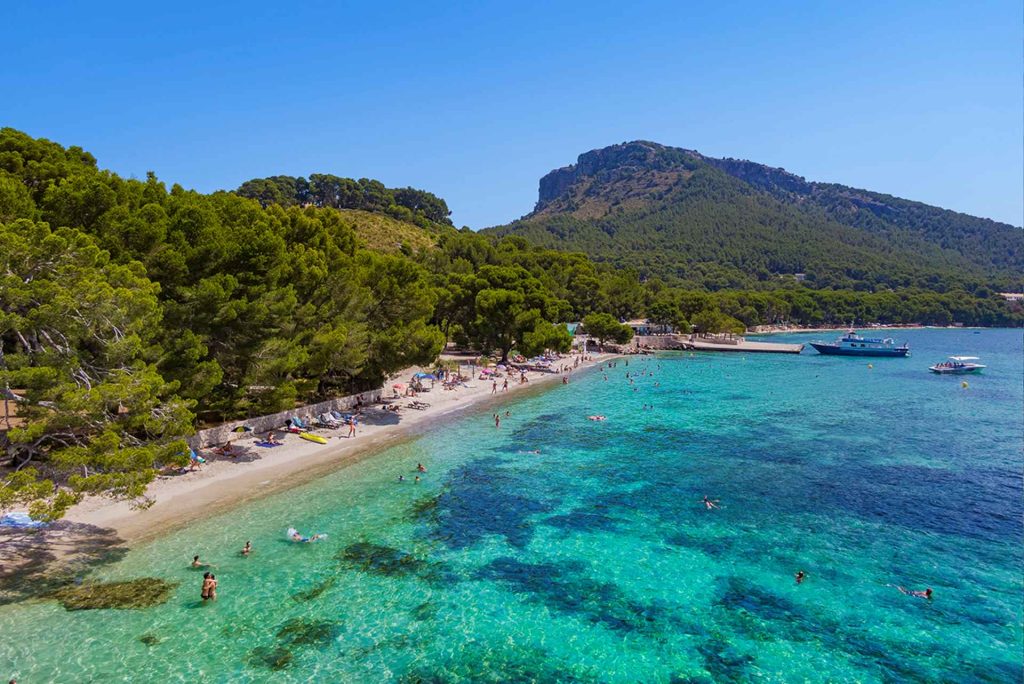
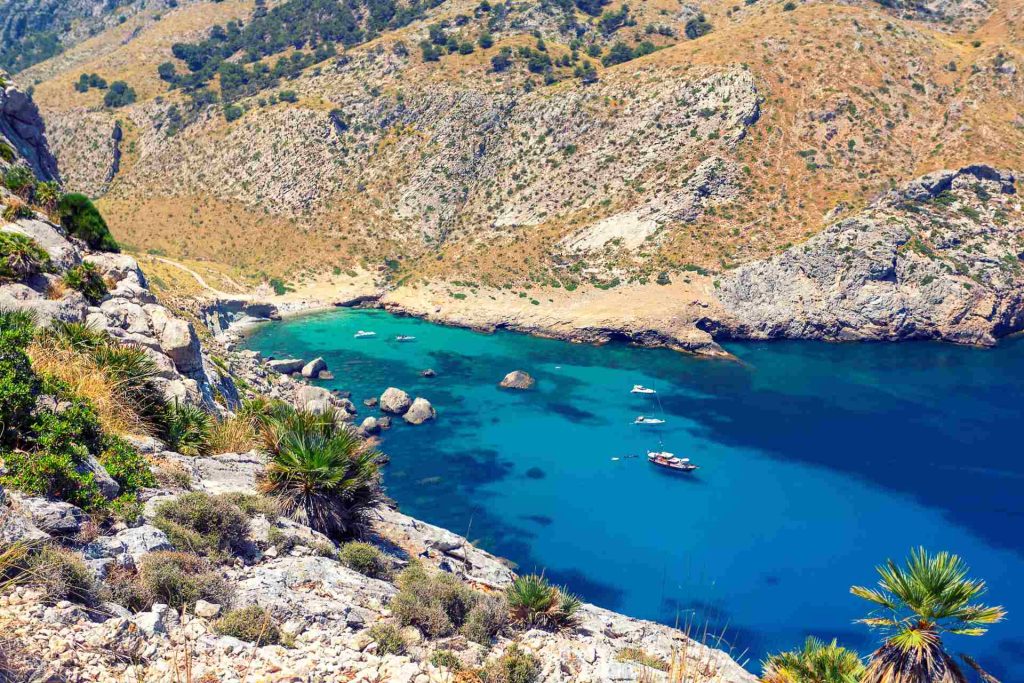
Platja de Formentor is the peninsula’s one proper beach: roughly a kilometre of pale sand backed by pine trees, facing the calm water of Cala Pi de la Posada where the resort itself sits. It is consistently ranked among Mallorca’s best beaches and, in season, draws a genuine crowd of day trippers arriving by boat and bus. For something quieter, Cala Murta is a pebble cove reached only on foot or by sea, around twenty minutes from the nearest car park, with no facilities and rarely more than a scattering of hikers or snorkellers. Cala Figuera, on the peninsula’s northern flank, is smaller again and entirely undeveloped, often described as one of Mallorca’s best coves.
Restaurants & Cafés
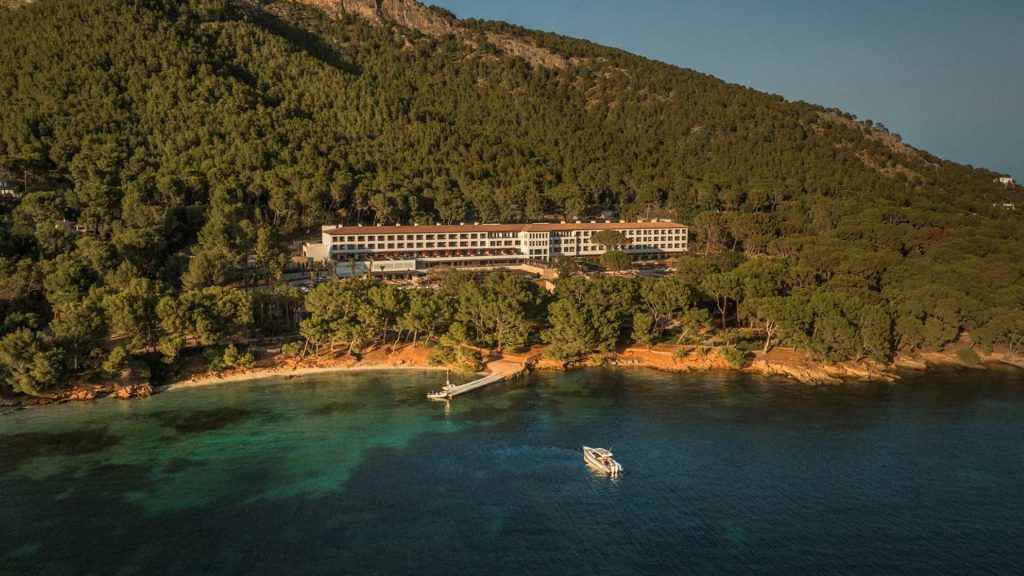
Dining directly on the peninsula is limited by design. Four Seasons Resort Mallorca at Formentor (the rebuilt and reopened version of the historic Hotel Formentor) runs several restaurants open to non-guests, from a beachfront seafood spot to a more casual poolside kitchen, plus a bar on Platja de Formentor itself. Beyond the resort, there is little else on the peninsula proper. Most people based here treat Puerto Pollença‘s harbourside restaurant scene, a short drive back along the same road, as their everyday option.
Schools
There are no schools on the Formentor peninsula, and none are realistically coming given the protected status of the land. Families based here send children to the state schools in Pollença or Puerto Pollença, or to Mallorca International School in Crestatx near Sa Pobla, the only international school serving the north of the island, roughly thirty to forty minutes away by car. It is one of the clearest signals that this is not a location built around a daily school run.
Outdoor activities
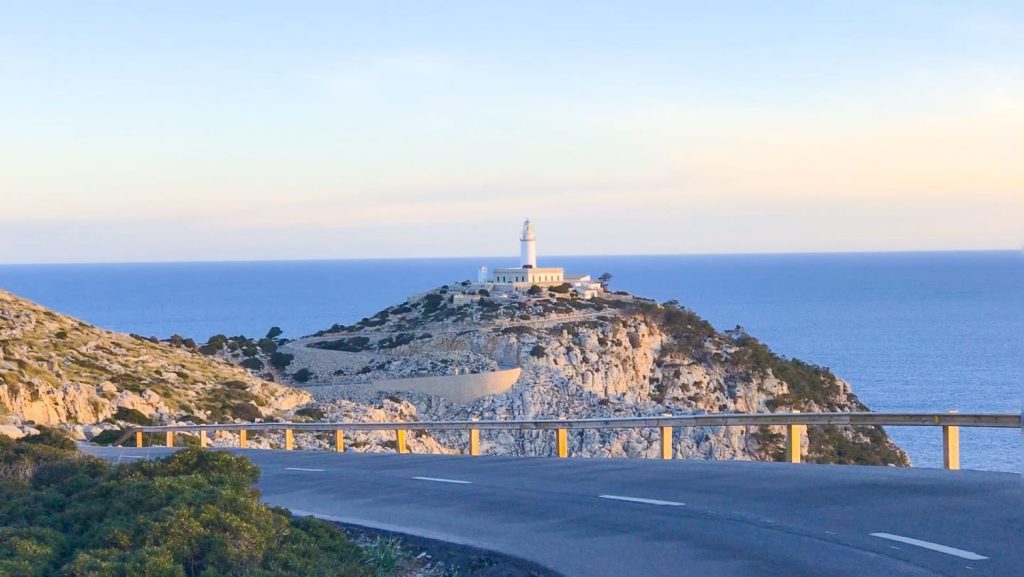
The road to the lighthouse is one of Mallorca’s best known road cycling climbs, and cyclists ride its bends year round, including during the summer months when the restrictions open the upper road exclusively to them, to pedestrians and to public transport. The clear water around the coves suits snorkelling more than diving, given the depth. Birdwatchers come specifically for Eleonora’s falcons, which breed on the cliffs facing north. Boat access has been part of daily life here since before the road existed: the resort still runs its own transfer service to and from Puerto Pollença, and several of the peninsula’s private properties keep their own moorings.
Community & International Life
Formentor does not have a community in the way Puerto Pollença or Pollença town does. There is no expat association, no weekly market, no fixed circle of neighbours dropping by. What it has instead is a lineage. Since Adan Diehl opened his hotel in 1929, the peninsula has drawn an unusually consistent, if small, cast of international owners and regular visitors, from the writers and Nobel laureates who gathered here for the Formentor literary prize in the 1960s to the string of European royals and film stars who have stayed at the hotel across nearly a century. The handful of private estates outside the resort follow a similar pattern: several have stayed within the same family for generations, changing hands rarely and quietly.
Social life, such as it is, centres on the resort rather than on a village or a club. People here are typically part time residents with an established base elsewhere on the island or in Europe, using Formentor as a private retreat rather than a full time home, and treating Puerto Pollença as their point of contact for everyday social life and errands.
Best Areas in Formentor
Formentor has almost no residential subdivisions in the way Puerto Pollença or Alcúdia do. There are, in practice, two distinct stretches of the peninsula worth knowing.
Around the hotel and Platja de Formentor
This is the one settled pocket of the peninsula: the resort, the beach it sits on, and a small number of private villas tucked into the pine forest nearby, several with direct sea access or a private mooring. It is the closest thing Formentor has to an address, and its properties rarely come to market.
Cap de Formentor and the protected headland
Beyond the beach, the road climbs through several kilometres of pure natural park toward the lighthouse: cliffs, pine forest, and the Mirador d’Es Colomer viewpoint, with essentially no private land and no prospect of any. It is included here for context rather than opportunity. This end of the peninsula is protected landscape, not a residential area, and buyers should not expect it to become one.
Things to know
Formentor is genuinely hard to reach by private car for part of the year. Since a 2018 pilot scheme cut peak season traffic by around 90 percent, the peninsula road has run under seasonal restrictions, and currently these apply daily from 15 May to mid October, between 10am and 10pm, with only public transport, taxis, authorised vehicles, cyclists and pedestrians allowed through. Residents can certainly apply for an exemption, but the exact dates and terms are reset each year by the Consell de Mallorca, so anyone counting on year round car access should check the current rules before committing to a purchase or a move.
There is no supermarket, pharmacy or general store on the peninsula. Puerto Pollença, roughly twenty minutes away by car outside restricted hours, covers all of that. Nearly the entire peninsula beyond the hotel and a small number of private plots falls within protected Serra de Tramuntana land, which is why the area has stayed largely unchanged for a century and is unlikely to see meaningful new construction. Being the exposed northern tip of the island also means real wind exposure: locals call it the meeting point of the winds, and the Tramuntana can blow hard here even on a calm day back in Puerto Pollença.
Who is it for?
- Second-home owners: Formentor suits someone who wants a private retreat used for a few weeks at a time, not a full time base with daily errands and a school run.
- Sailing & nautical buyers: several of the peninsula’s frontline properties come with direct sea access or a private mooring, and arriving by boat from Puerto Pollença remains a normal, and historic, way in.
- Investors: the appeal here is scarcity rather than yield. Genuinely new stock essentially never appears, which supports long term value, and a number of existing villas operate as high end holiday lets, though any holiday rental licence (ETV) needs to be checked and confirmed for the specific property rather than assumed.
Thinking of Buying?
Formentor may be the rarest micro market covered on this site. With almost the entire peninsula protected and no meaningful new development possible, the small number of villas here change hands infrequently, and each one is genuinely singular rather than one of a comparable set. Our current Formentor listings are the place to start; if total seclusion is more than you need, the wider Pollença property market, within the same bay, offers considerably more everyday convenience.
FAQs
Not in the way most Mallorcan towns have one. Formentor has no village centre and a very small number of private homes, most owned by people who use them as a seasonal retreat rather than a full time residence. Its identity has always been tied more to the historic hotel than to a resident population.
Yes, and it is a genuinely normal way to arrive. Boat transfers between Puerto Pollença and Formentor have been part of the peninsula’s routine since the hotel opened in 1929, when the road itself was not yet finished, and the resort still runs a private boat service today.
No. Everyday services, including a supermarket, pharmacy and post office, are all in Puerto Pollença, about twenty minutes away by car outside the seasonal traffic restrictions.
Outside the restricted season it is. In 2026 the road is closed to private cars daily from 15 May to mid October, between 10am and 10pm, with only public transport, taxis, cyclists, pedestrians and Formentor residents allowed through during those hours. The exact dates are set fresh each year, so this is worth confirming close to your travel or move date.
Yes. The peninsula forms the northeastern tip of the Serra de Tramuntana, which UNESCO recognised as a World Heritage Cultural Landscape in 2011, and almost all of the land beyond the hotel and a small number of private estates is protected from development.