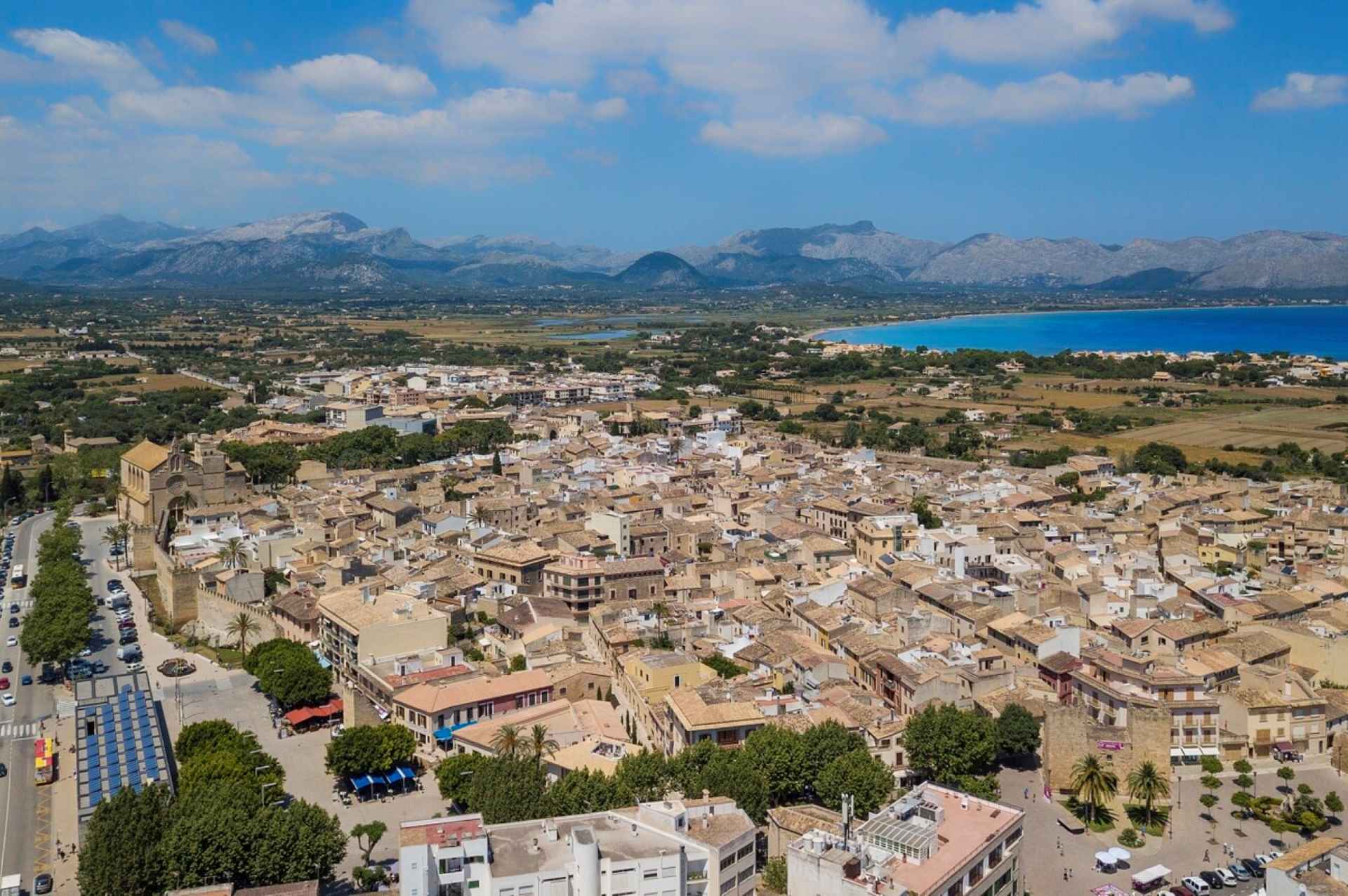
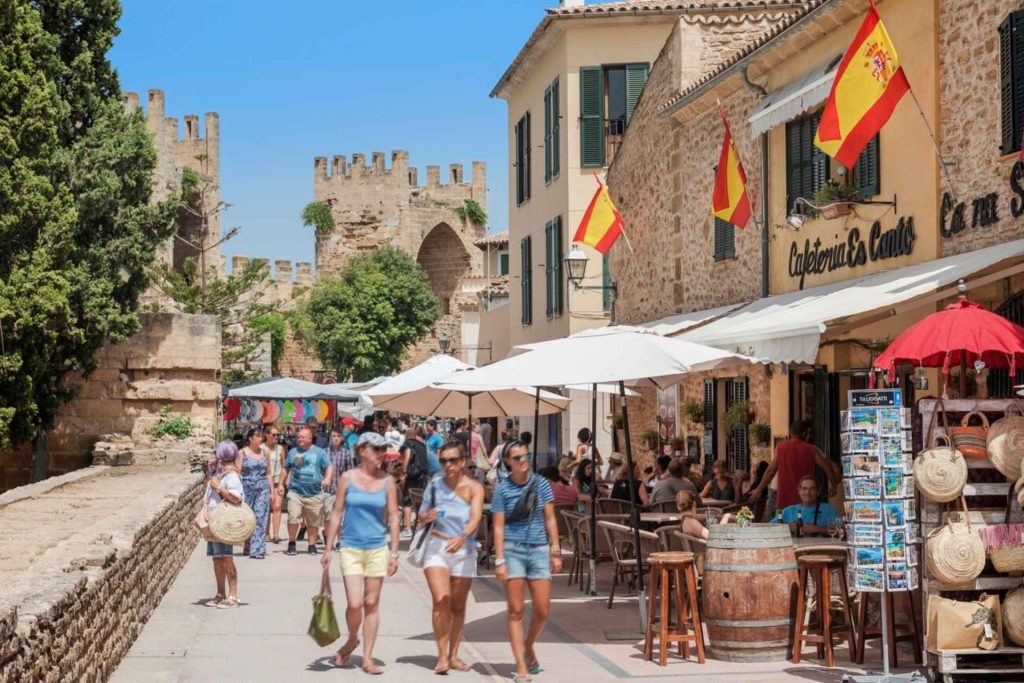
Alcúdia is the only town in Mallorca where the medieval walls still form a complete, walkable circuit. They stand just a few hundred metres from the excavated streets of Pollentia, the Roman city that came before them.
By Iris GrünewaldFounder & CEO, Balearic PropertiesUpdated 5 minutes to read
Share this guide
Even Palma’s walls, once far more extensive, were largely demolished in 1902 to make way for its ring roads. Inside Alcúdia’s walls, a market has set up twice a week on the same paving for centuries. Outside them, the bay curves past a 744-berth marina and Mallorca’s only seaside golf course. Nearby sits one of the largest protected wetlands in the Mediterranean. Few places on the island let you choose between history, coastline and open countryside without changing address.
Alcúdia at a glance
Where
North Mallorca, between the bays of Pollença and Alcúdia
From Palma Airport
Under an hour by the Ma-13
Apartment asking price
€4,592 per m² on average, October 2026
House asking price
€6,936 per m² on average, October 2026
Market days
Tuesday and Sunday, inside the old town walls
Marina
Alcudiamar, 744 berths, plus Marina de Bonaire
Why live here
For an international buyer, Alcúdia solves a problem most north-coast towns cannot. It works as a full-time address, not just a summer one. The Ma-13 puts Palma and its airport under an hour away. That matters for anyone still commuting for work, or hosting visitors at short notice. The nearest international school, Mallorca International School in Sa Pobla, is a British-curriculum option roughly twenty minutes inland. As a result, Alcúdia is a rare option in the north for an international education close to home. Families avoid the daily hour-long drive that’s typical elsewhere. A public health centre operates in the old town itself. Hospital Comarcal d’Inca, the regional referral hospital, is about half an hour south.
What makes the case beyond logistics is variety within one municipality. A buyer can choose a townhouse inside the walls, a hillside villa near Bonaire, or a flat by the marina. There’s also a plot near the golf course at Alcanada. All the while, they stay part of the same town, sharing the same market days and festival calendar. Few places in the north let a household weigh history, coastline and countryside so directly, without ever leaving the municipality.
For anyone comparing the north coast, Alcúdia sits within a short drive of Puerto Pollença and Pollença. It’s also within reach of the far more exclusive Formentor, further along the coast. Each of the three strikes a different balance of privacy, character and price.
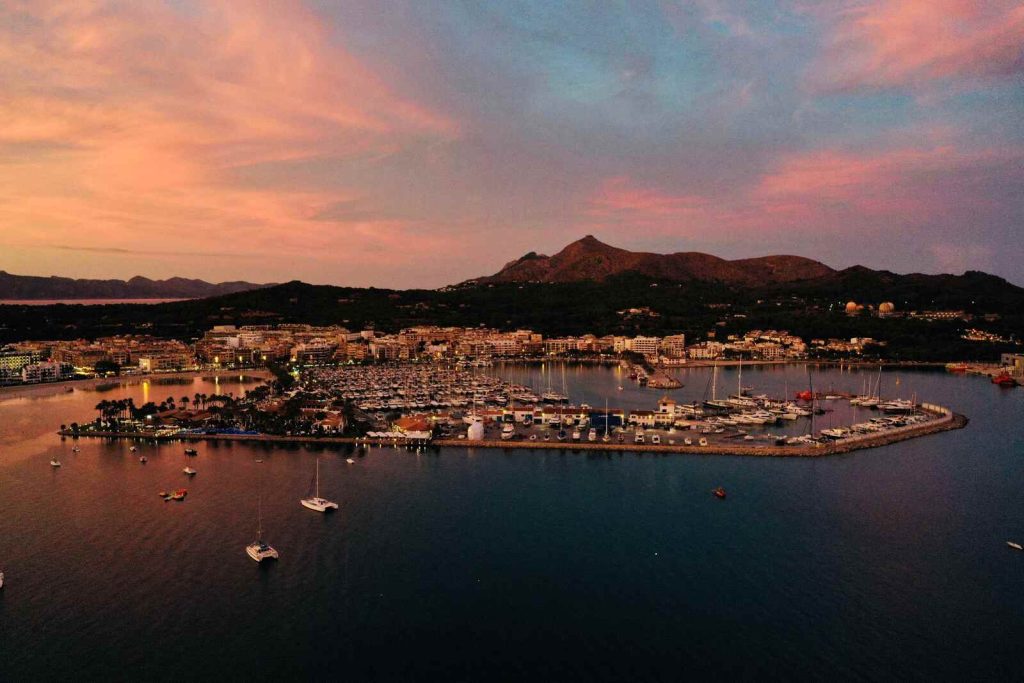
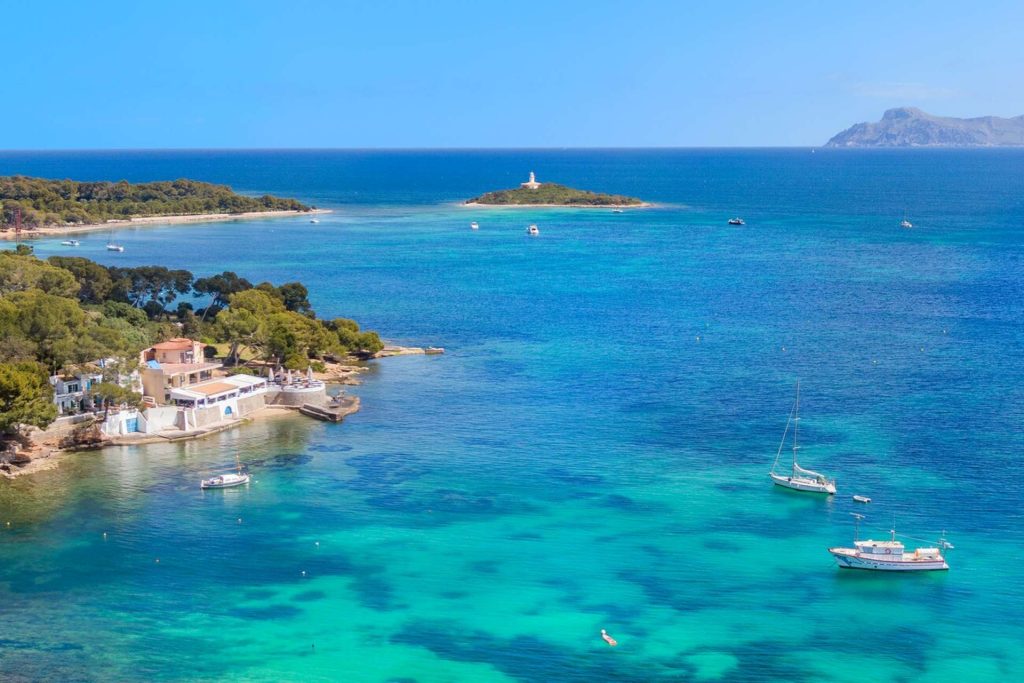
Aerial view of Alcudiamar marina at sunset.Aucanada beach with the island of Aucanada and its lighthouse in the background.
1 / 3
Beaches
Platja d’Alcúdia runs for several kilometres of fine sand around the bay. It’s the default beach for most residents, easily reached on foot or by bike from Port d’Alcúdia. For something quieter, Mal Pas and the small cove at Aucanada sit below the villa neighbourhoods on the town’s eastern edge. Both are rocky and locals-first, rather than resort beaches. Coll Baix, reached only on foot through pine woods, is the genuine outlier. There’s no road access and no facilities, only cliffs and clear water that keep it from feeling crowded, even in August. Just offshore near the golf course, the small island of Alcanada and its nineteenth-century lighthouse mark the turning point of the bay. For how these compare with the rest of the island, see our Best Beaches in Mallorca guide.
Restaurants and cafés
The old town’s dining scene concentrates around the Passeig Mare de Déu de la Victòria and the streets near the market. Tapas bars spill onto the pavement on market mornings. Port d’Alcúdia’s marina front carries the more polished end of the scene. That includes Maca de Castro, the area’s Michelin-starred restaurant, alongside Alcanada Golf’s own sea-facing terrace restaurant. Between the two, Alcúdia has both the everyday café culture of a working town, and, on the port side, dining that draws visitors from across the island.
Schools
Mallorca International School, based in Crestatx near Sa Pobla, is the only international school serving the north of the island. It’s the realistic option for Alcúdia families who want a British curriculum without a long daily commute. Most other international schools cluster around Palma and the southwest instead, roughly fifty minutes or more away. Families who prefer full immersion in the Spanish and Catalan system have the town’s state and concertado schools on their doorstep. Compare curricula, admissions and the daily school journey directly with each school before choosing where to live.
Outdoor activities
Club de Golf Alcanada, designed by Robert Trent Jones Jr. and opened in 2003, is Mallorca’s only course built directly on the coast. It has even hosted the Rolex Challenge Tour Grand Final, a DP World Tour event, on its closing holes. The 744-berth Alcudiamar marina anchors a genuine sailing community, from day-sailors to long-term liveaboards. Alongside it, the smaller, private Marina de Bonaire (El Cocodrilo) offers a quieter mooring option a few minutes along the coast. Inland, S’Albufera de Mallorca is the largest wetland in the Balearics. It covers close to 1,700 hectares and is home to over 300 recorded bird species. It also offers flat, largely traffic-free cycling and walking routes that connect Alcúdia to Playa de Muro, without ever touching a main road.
Community and international life
Alcúdia’s international community has deep roots. British and German visitors have been coming here since package tourism took off along this coast in the 1960s and 70s. As a result, a meaningful share of today’s second-home owners are second or third-generation returners, not first-time buyers. That history shows up in daily life more than in any statistic. German and English are spoken as a matter of course in the old town’s cafés and along the port. Meanwhile, the Tuesday and Sunday market, one of the largest and longest-running in Mallorca, draws a genuinely mixed crowd of residents, not only day-trippers.
Sailing forms its own community around the 744-berth Alcudiamar marina, from weekend racers to long-term liveaboards. The town’s festival calendar is anchored by the Festes de Sant Jaume in late July and the Roman-themed Fira d’Alcúdia every October. Both function as a genuine meeting point between local and international residents, rather than a tourist spectacle staged for outsiders. Port d’Alcúdia’s fishing quarter adds its own smaller Sant Pere festival in late June. It centres on a boat procession that longtime residents, whatever their nationality, treat as a fixed point in the year.
Who is it for?
Families
Beach access, a safe walkable old town and a nearby international school make this workable as a full-time family base. It’s not just for holidays.
Retirees
A genuine year-round town, not a summer shell. Daily amenities, a local health centre and an established international community are already in place.
Second-home owners
Port d’Alcúdia’s tourist infrastructure and the old town’s character both suit a part-time property. It only needs to work a few weeks a year, and stay easy to maintain the rest of the time.
Investors
Port d’Alcúdia’s established rental demand is a real asset. ETV holiday-letting licence availability needs checking directly, though, rather than assumed, since it changes.
Sailing & nautical buyers
The 744-berth Alcudiamar marina and Mallorca’s only seaside golf course sit side by side here. Together they give this stretch of coast a genuinely active nautical community, not just moorings.
Cyclists
Flat routes through S’Albufera and along the coast toward Playa de Muro suit serious riders. There’s no need to leave the municipality.
Alcúdia on the map
The walled town, the port, the villa areas and the nature around them. Tap a pin to read about the place, filter by what you are looking for, and zoom in to see where it sits.
Alcúdia is one municipality with very different addresses: inside the walls, by the port, or in the villa areas along the coast.
Old Town (within the walls)
Homes
Townhouses
Suits
Walking to everything, character over garden
Life inside the walls means cobbled streets, a genuine year-round population and the twice-weekly market on your doorstep. It suits buyers who want to walk to everything, and don’t mind trading garden space for character and location. See.
The working port and main beach strip, busiest in summer and genuinely lively rather than purely residential. It suits buyers who want marina access, restaurants and beach within walking distance. It’s less suited to those who need the quiet of the old town or the hills. See.
Bonaire is an established hillside villa area with its own small marina, Marina de Bonaire (known locally as El Cocodrilo). Built in 1982, it holds around 320 berths for boats up to 17 metres. It’s considerably quieter and more private than the main marina in Port d’Alcúdia. Bonaire suits buyers who want space, sea views toward Pollença, and a mooring close to hand. It still leaves a short drive to the old town and the beaches. See
The most exclusive of Alcúdia’s residential pockets, tucked between the old town and Bonaire on the eastern coastline. It has direct or near-direct access to the water. It suits buyers who prioritise privacy and sea proximity over walkable amenities. See
Named for the golf course and the small lighthouse islet just offshore. Alcanada is the quietest and most golf-oriented of Alcúdia’s areas, with villas set among pine and olive groves. It suits buyers who want the course on their doorstep, and are happy being a short drive from everything else. See
Apartments in Alcúdia were listed at an average of €4,592 per m² in October 2026, and houses at €6,936 per m². Comparing the twelve months to September 2024 with the twelve months to September 2026, average asking prices rose by about 13% for apartments and 15% for houses. Location, views and the exact street matter more to price here than size.
Apartments€4,592/m²Average asking price, Oct 2026
Houses€6,936/m²Average asking price, Oct 2026
Apartments, 2 years+13%Houses +15% over the same periods
Time on market77 daysAverage for apartments listed since Oct 2025
Asking prices in Alcúdia since 2023, € per m²
Quarterly, Q4 2023 to Q3 2026. Hover or tap the chart to read each quarter.
ApartmentsHouses
Show the quarterly figures
Period
Apartments
Houses
Q4 2023
€3,922
€5,884
Q1 2024
€3,831
€5,735
Q2 2024
€4,097
€5,938
Q3 2024
€4,275
€5,938
Q4 2024
€4,300
€5,922
Q1 2025
€4,105
€6,139
Q2 2025
€4,255
€6,314
Q3 2025
€4,324
€6,415
Q4 2025
€4,538
€6,647
Q1 2026
€4,513
€6,798
Q2 2026
€4,564
€6,730
Q3 2026
€4,629
€6,898
What apartments are listed for
Apartments for sale in Alcúdia by asking price, November 2026 (188 listings).
Under €400k
92 · 49%
€400–600k
49 · 26%
€600k–1m
31 · 16%
Over €1m
16 · 9%
How Alcúdia compares with nearby areas
Average asking price per m², as published in each guide (Casafari Area Insights). The areas measured are not identical, so read this as a guide to price levels, not a like-for-like comparison.
Almost half of the apartments on the market are listed below €400,000, with the middle listing in the €400,000 to €500,000 band, and a smaller tier of 16 apartments above €1 million. Asking rents for apartments averaged around €22 per m² a month over the past year, which against purchase prices gives an indicative gross yield of about 5.7% before costs, taxes and empty periods.
Source: Casafari Area Insights, average asking prices per m² of active listings in the municipality of Alcúdia, outliers excluded. Data retrieved 4 November 2026. Asking prices are not final sale prices: the Balearic Government’s Housing Observatory reported in September 2026 that advertised prices were around 38% above transaction prices. For the island-wide picture, see Mallorca property prices by area.
Apartments in Alcúdia are listed at an average of €4,592 per m² and houses at €6,936 (Casafari, October 2026). To compare Alcúdia with the rest of the island, see our Mallorca property prices by area.
Alcúdia’s property market spans everything from historic townhouses inside the walls to marina-side apartments and hillside villas. That range is part of what makes the area work for such a wide mix of buyers. For the figures, floorplans and current listings, our team can walk you through what’s actually available.
Things to know
Alcúdia is genuinely seasonal, in a way it’s worth being honest about. Between June and September the population multiplies several times over. The coast road (Ma-12) between the old town and Port d’Alcúdia slows to a crawl at peak times. The Tuesday and Sunday market also extends through most of the historic centre then, rather than just its usual square. Outside July and August, though, the town reverts to a quieter, distinctly local rhythm. This off-season character is exactly what year-round residents describe as the real Alcúdia.
June to September
the population multiplies several times over and the Ma-12 coast road slows at peak times
Holiday rentals
ETV licence availability must be checked with the local authorities or an adviser, not assumed
Healthcare
CS Es Safrà in the old town, a primary care unit in Port d’Alcúdia, Hospital Comarcal d’Inca about 30 minutes away
Palma Airport
under an hour via the Ma-13
Languages
English and German routinely spoken in shops, restaurants and services
Before you buy in Alcúdia
A few things worth checking before you commit. Each one links to its source.
Public transport
There is no train in Alcúdia; the nearest stations are on line T2 (Muro, Sa Pobla). TIB bus 302 runs Can Picafort – Port d'Alcúdia – Alcúdia – Inca – Palma. (TIB – bus line 302)
Seafront homes
Under the Coastal Law, a protection easement runs inland from the shore: 20 m where the land was already urban before the law, 100 m where it was not. New residential use is banned inside it. If you look at a home on the water in Port d'Alcúdia or Alcanada, check where the line falls on that plot. (MITECO – Coastal public domain)
Holiday rentals
Decree-law 4/2025 bans new tourist rental places in apartment buildings across the Balearics, and elsewhere new places can only be activated if the same number is retired first. If rental income is part of the plan, buy a property that already holds a licence and have its number checked. (Govern de les Illes Balears – Decree-law 4/2025)
Fincas and rustic land
Outside the town most land is rustic. A new house on common rustic land generally needs a plot of at least 14,000 m², protected categories need more, and municipal planning can raise the minimum. Ask the Ajuntament for a cèdula urbanística before buying a plot or a finca you plan to extend. (Última Hora (Consell de Mallorca))
Checked November 2026. Rules change: confirm them with a lawyer before buying.
FAQs
Is the old town or Port d’Alcúdia better for year-round living?
It depends on what you want daily life to feel like. The old town is quieter, more local and walkable, with the market and cafés on your doorstep. Port d’Alcúdia, by contrast, is busier and more geared toward the beach and marina. Restaurants and amenities stay open longer through the season there.
What’s the school situation like for international families?
Mallorca International School in nearby Sa Pobla is the only international school serving the north of the island. It’s the practical option for most Alcúdia families, roughly twenty minutes away. Most other international schools are near Palma, closer to fifty minutes or more.
Does S’Albufera Natural Park affect daily life for nearby residents?
Mostly in a positive way. It gives residents in and around Alcúdia direct access to flat cycling and walking routes. There’s also a genuinely quiet nature reserve just a few minutes from the coast, rather than any real disruption to daily life.
How busy does Alcúdia get in summer?
Considerably busier than the rest of the year. The population multiplies several times over between June and September. The coast road between the old town and the port can be slow at peak times too. Outside high season, though, the pace is much closer to a typical small Mallorcan town.
What healthcare is available in Alcúdia?
There’s a public health centre inside the old town, plus a further primary care unit in Port d’Alcúdia. Hospital Comarcal d’Inca, the regional hospital, is around half an hour away for anything beyond primary care.
Is Alcúdia well connected to Palma and the airport?
Yes. The Ma-13 motorway puts both under an hour’s drive. That’s one of the reasons Alcúdia works for people who still need to travel for work, not only for retirees or second-home owners.
 Deutsch
 English
 Español