 Deutsch
 English
 Español
Living in Sóller
Sóller does not look like the rest of Mallorca, and there is a specific reason for that. When a citrus blight wiped out much of the valley’s orange and lemon crop in 1865, thousands of Sollerics emigrated to France to rebuild their fortunes in the fruit trade, then came home decades later and built French-style Art Nouveau mansions along the main streets. That imported elegance, paired with a working fishing port, a century-old wooden train, and mountains keeping day-trip crowds at arm’s length, is what makes Sóller feel like a real town rather than a resort. It suits people who want mountains, sea and a functioning high street in one place, without becoming Deià’s smaller, pricier neighbour.
Why Live Here
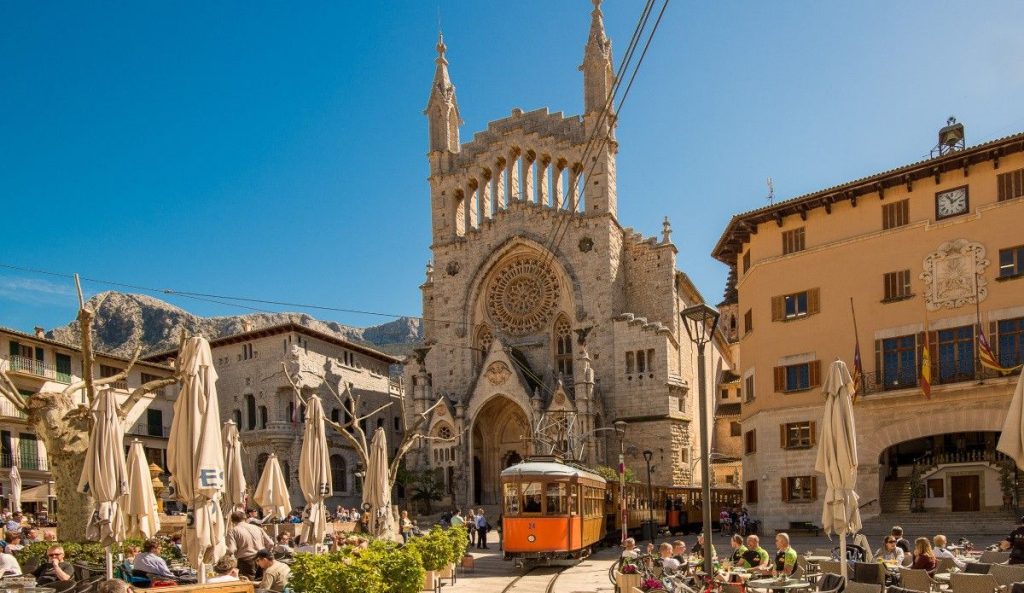
Sóller works as a place to live largely because of one piece of infrastructure: the road tunnel that opened in February 1997 and has been toll-free for every driver, not just residents, since December 2017. Before it existed, the drive to Palma meant close to an hour over the Coll de Sóller’s hairpin bends. Now it’s a level, three-kilometre run into the capital, and Palma airport, in around 25 to 30 minutes, without cutting yourself off from the island for mountain scenery and a proper town centre. The valley also has its own historic transport, still in daily use rather than kept purely for tourists: the Ferrocarril de Sóller, a narrow-gauge train running the 27 kilometres from Palma since 1912, and the tram connecting the town to Port de Sóller since 1913.
The town itself has what a resort satellite usually lacks: a year-round population of around 13,700 spread across Sóller, Port de Sóller, L’Horta and Biniaraix, two public primary schools (CEIP Es Puig and CEIP Ses Marjades) and a secondary school, IES Guillem Colom Casasnoves, all inside the valley. Compare that with Deià or Valldemossa, a short drive further along the same range: both are smaller and pricier, and lean on Sóller or Palma for most day-to-day services. Sóller has its own doctors, its own weekly market, its own schools and its own working economy that existed long before tourism did. People live here year-round because the town supports that, not only because the views are good.
Lifestyle
Beaches
Sóller is not, first and foremost, a beach town, and it is worth being upfront about that rather than overselling it. Port de Sóller’s horseshoe bay holds the valley’s two real beaches: Platja d’en Repic, a quieter stretch of golden sand favoured by families, and Platja des Través, busier and closer to the tram stop and marina. Both sit inside a sheltered natural harbour, so the water tends to stay calm even when the coast outside is choppier. Anyone who wants Mallorca’s long sweeps of open sand, the kind found around Alcúdia or Puerto Pollença, should treat this as a mountain-and-port lifestyle with good, small beaches attached, not a beach-first move. Our Best Beaches in Mallorca guide covers those options in more depth.
Restaurants & Cafés
Plaça de la Constitució, the main square in front of Sant Bartomeu church, is where daily life in Sóller happens: café tables spill out under the church facade, and freshly squeezed orange juice from the valley’s own citrus, sold from stalls right on the square, is close to a local institution. The town’s dining leans toward produce-driven Mallorcan cooking, with the citrus and olive groves that surround the valley showing up on menus more directly than in most other parts of the island. Port de Sóller’s promenade adds a second, more seafood-focused dining strip around the harbour, busiest in summer evenings when the fishing boats and yachts share the same stretch of water.
Culture & Heritage
The clearest physical evidence of Sóller’s 19th-century trade with France is Can Prunera, a Modernista mansion built between 1904 and 1911 by a Solleric family who made their fortune in the fruit and liqueur trade in Belfort, now open as a museum with an art collection that runs from Miró to Picasso. It is one of several Art Nouveau buildings along Carrer de sa Lluna and around the main square, alongside Sant Bartomeu church itself, whose facade is attributed to the Catalan architect Joan Rubió i Bellver. The town’s biggest annual event, Es Firó, takes place on the second Monday of May and re-enacts an actual 1561 battle in which the townspeople repelled an attacking pirate fleet; it is a genuinely local celebration rather than one staged for visitors, with residents taking the roles on both sides.
Schools
Families relying on state education have three options inside the valley itself: two public infant and primary schools, CEIP Es Puig and CEIP Ses Marjades, and one public secondary school, IES Guillem Colom Casasnoves, all teaching through the Balearic bilingual Catalan-Spanish curriculum. What Sóller does not have is a British, German or IB-curriculum international school within the valley; those are concentrated around Palma and the southwest coast, which in practice means a commute of roughly 25 to 30 minutes each way through the tunnel for families who want that specific option. It is a genuine trade-off worth weighing honestly rather than glossing over. Compare curricula and admissions directly with each school, and try the daily journey from Sóller before choosing a home.
Outdoor Activities
The Serra de Tramuntana, the mountain range that forms the valley’s walls, was declared a UNESCO World Heritage Cultural Landscape in 2011, recognised for its terraced groves and dry-stone construction as much as for its scenery. That heritage is walkable: the Barranc de Biniaraix, a dry-stone path climbing out of the hamlet of the same name, is one of the best-known routes on the island and forms part of the long-distance GR221. Road cyclists know the valley for the climb up to the Coll de Sóller, a regular fixture on training routes out of Palma. Down at sea level, Port de Sóller’s natural harbour is home to Club Nàutic Sóller, a sailing club founded in 1948, and the Jardí Botànic de Sóller, a botanical garden focused on Balearic and Mediterranean flora, sits just outside the town on the road to the port.
Community & International Life
Sóller’s international community is older than most on the island, and it runs in an unusual direction: the valley’s largest non-Spanish-born population is historically French, a direct legacy of the 19th-century citrus trade, and many of those families have since taken Spanish nationality rather than remaining registered as foreign residents.Among residents without Spanish citizenship, British and German nationals are currently the largest groups, alongside smaller but well-established Swedish and Italian communities, plus a more recent influx of remote workers drawn by the valley’s setting and fast internet.
What holds the different groups together is less any single club and more the rhythm of the town itself: the Saturday market in Plaça de la Constitució, the café culture around the square, and Es Firó in May, which by long tradition pulls in residents of every background rather than staying a purely local or purely foreign event. Port de Sóller’s sailing scene, centred on Club Nàutic Sóller, adds a second, more nautical social circuit, particularly through the warmer months.
Best Areas in Sóller
Sóller Town
The historic centre, built around Plaça de la Constitució and Carrer de sa Lluna, is where the valley’s Modernista architecture and daily café life are concentrated. It suits people who want to walk to a bakery, a doctor and a church square without needing a car for daily errands, and who are drawn to a town with real, working streets rather than a resort strip designed around a beach. Properties for sale in Sóller covers current listings across the town and valley.
Port de Sóller
Three kilometres downhill from the town, connected by the vintage tram, Port de Sóller wraps around a natural harbour with a working marina, a promenade, and the valley’s two small beaches. It has a livelier, more seasonal feel than the town centre, busier with visitors in summer and quieter out of season, and suits buyers who want sea views and boat access without living directly in a beach resort. View Port de Sóller’s available property here.
Fornalutx
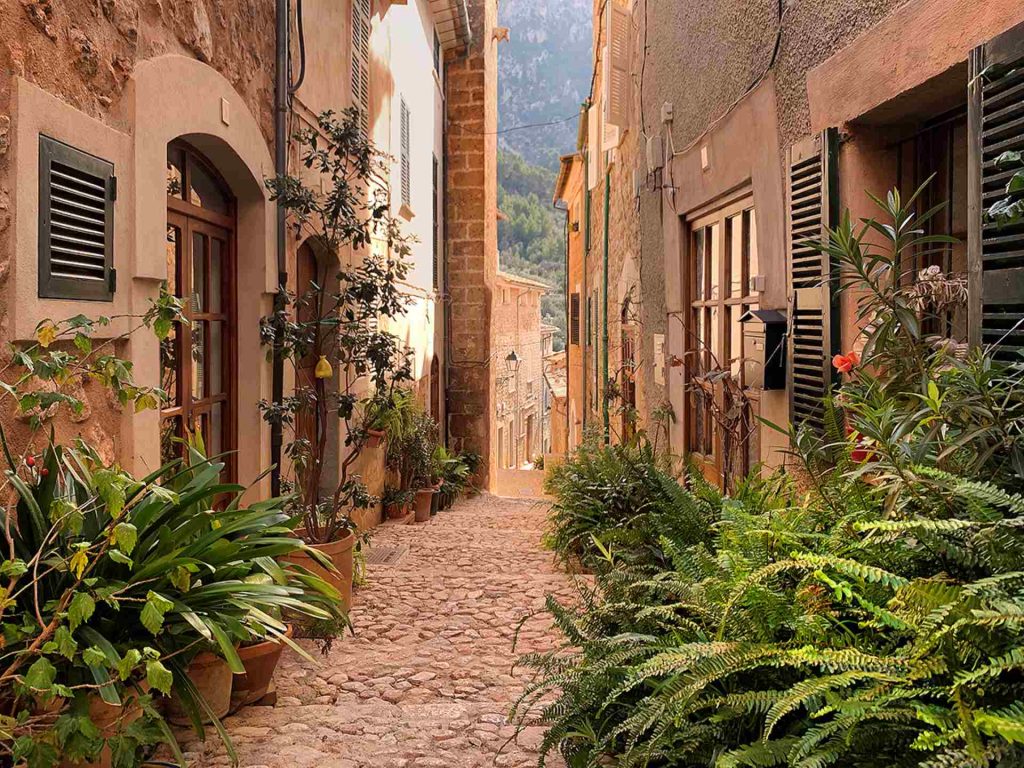
Technically its own municipality rather than a district of Sóller (the two split administratively in 1837, after centuries as one town), Fornalutx is close enough, around seven kilometres and a short drive away, to function as part of the same daily life as the valley below. It has been a member of Spain’s official Association of the Most Beautiful Villages since 2017, and its steep, stone-paved lanes and terraced orange groves are the reason why. It suits buyers drawn to a smaller, quieter, more rural setting, with the caveat that its hillside streets are genuinely steep, which matters for anyone with mobility concerns. View Fornalutx listings here.
Biniaraix
A small hamlet within Sóller’s own municipal boundary, Biniaraix is little more than a square, a church, and a scattering of houses at the foot of the Barranc de Biniaraix hiking route. It has almost no shops or services of its own, which is exactly its appeal for buyers who want genuine rural quiet with the town’s amenities still a short drive or walk away. View Biniaraix listings here.
Things to Know
The valley has one road in and out through the tunnel, which means accidents, breakdowns or roadworks can back up traffic in a way that a town with several access routes would not experience. In high season, that single-road effect combines with day-trippers arriving by the vintage train, which alone carries around a million passengers a year, and by the tram; Sóller town and, in particular, Fornalutx, feel noticeably busier from late spring through early autumn than they do the rest of the year.
Short-term holiday letting in the Balearics operates under an ETV licence system with caps that are set and revised by the regional and municipal authorities; anyone planning to buy with rental income in mind should check current availability and rules for the Sóller valley directly with the local authorities or a local gestor rather than assume a licence will be straightforward to obtain. The valley’s mountain setting also means a slightly different microclimate to the open coast: more shade and shelter from the Tramuntana, and a reputation for being a touch cooler and greener than Palma or the beach resorts, though this is a general pattern rather than a precise, verified figure.
Who Is It For?
- Families: State schooling is genuinely available inside the valley, from infant school through to secondary, which is not true of every part of the island; families wanting a specific international curriculum will need to weigh that against a daily commute through the tunnel.
- Retirees: The town centre is walkable and self-sufficient, with a doctor’s surgery, pharmacy and weekly market on the doorstep, though the steep, stepped streets of the old town and of Fornalutx are worth walking yourself before buying if mobility is a consideration.
- Second-home owners: A working town rather than a seasonal resort, Sóller stays livable and open out of season, which suits owners who want somewhere that still functions in January, not just August.
- Investors: Rental demand exists around the valley’s hiking, cycling and heritage tourism. Despite this, authorities cap and regulate ETV holiday-letting licences, so you should verify their availability rather than assume it.
- Sailing and nautical buyers: Port de Sóller’s natural harbour and Club Nàutic Sóller, founded in 1948, give the port a genuine, long-established sailing culture rather than a marina built purely for tourism.
- Cyclists: The climb to the Coll de Sóller is a fixture of road-cycling routes out of Palma, and the valley sits inside the wider Tramuntana network favoured by serious riders training on the island.
- Heritage and architecture buyers: Sóller’s Modernista buildings, led by Can Prunera, give it a genuinely distinct architectural identity within Mallorca, of particular interest to buyers drawn to the town’s French-influenced history as much as its Mallorcan setting.
Thinking of Buying?
If Sóller’s combination of mountains, a working port, and an actual town centre sounds like somewhere you could live rather than just visit, the next step is seeing what is currently on the market. At Balearic properties, we cover listings across the town, the port and the surrounding valley, from apartments near Plaça de la Constitució to fincas in the hills toward Fornalutx.
FAQs
Not necessarily inside the town itself, where the centre, the schools and the Saturday market are all within walking distance, and the tram connects the town to Port de Sóller without a car. A car becomes more useful, though close to essential, for reaching Fornalutx, Biniaraix, or anywhere outside the valley, since bus frequency to outlying villages is limited.
Yes, with one honest caveat. The valley has its own public infant, primary and secondary schools, a genuine year-round community, and safe, walkable streets in the town centre. Families who want a British, German or IB international curriculum specifically will need to factor in a commute of around 25 to 30 minutes each way through the tunnel to reach schools clustered near Palma and the southwest coast.
Not administratively. Fornalutx was originally part of Sóller’s municipality but became independent in 1837, so it has its own town hall and mayor. In practice, though, it sits inside the same valley, around seven kilometres from Sóller town, and functions as part of the same day-to-day community, sharing many of the same shops, schools and services.
Sóller town and Port de Sóller both see a significant rise in day-trippers from late spring through early autumn, arriving by the vintage train, the tram, and the road tunnel. Fornalutx, given its small size and single main square, can feel especially busy at peak times. Outside that window, both the town and the port return to a quieter, more local pace.