 Deutsch
 English
 Español

Living in Deià and Valldemossa
Robert Graves came to Deià in 1929 and never really left; Chopin and George Sand spent one difficult winter in Valldemossa’s monastery a century earlier and left behind Mallorca’s most famous piece of music-history tourism. Two mountain villages, ten minutes apart on the same stretch of the Serra de Tramuntana, both shaped as much by the artists and writers who settled here as by the terraced hillsides themselves. This is not a beach-and-marina lifestyle. It suits people drawn to stone houses, olive groves and a genuinely international creative community, in a setting protected as UNESCO World Heritage rather than developed into resort infrastructure.
Why live here
Deià and Valldemossa sit inside the Serra de Tramuntana, inscribed by UNESCO in 2011 as a Cultural Landscape World Heritage Site, which means the terraced, dry-stone mountainside around both villages is a protected landscape by law, not just by reputation. That protection is part of the appeal: neither village has been allowed to sprawl, so the view a buyer sees today is close to the one Robert Graves or Archduke Ludwig Salvator saw a century ago. Valldemossa is around 20 kilometres and a 25-minute drive from Palma; Deià is a little further, around 29 kilometres and 35 minutes, along the same MA-10 mountain road. Both are close enough for a working link to Palma without feeling like a suburb of it, and the same road continues on to Sóller, the larger valley town most people pair with Deià and Valldemossa when house-hunting this stretch of coast.
The two villages have drawn foreign writers, painters and musicians for close to a century, starting with Archduke Ludwig Salvator of Austria in the 19th century and continuing through Robert Graves from 1929 onward, and that legacy still shapes daily life: small galleries, a genuine literary and artistic community, and a slower pace built around the mountains rather than the coast. It’s a lifestyle bought deliberately, not by default, and it suits people who want that trade specifically.
Lifestyle
Beaches
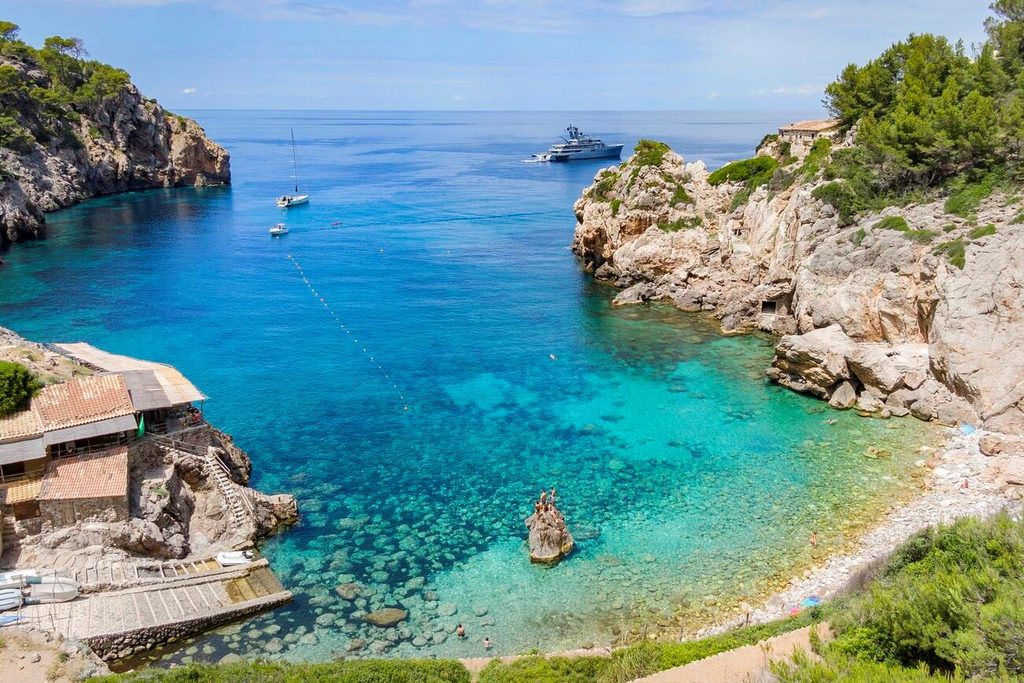
Neither village has a resort beach, and that’s by design. Cala Deià is a small pebble cove at the bottom of a steep path below Deià, with a couple of simple beach restaurants open in season. Llucalcari, a scattered hamlet between Deià and Sóller, has an even smaller, quieter cove reached on foot. Valldemossa’s own coastline at Port de Valldemossa is a tiny rocky landing with a handful of boat moorings rather than a beach at all. Swimming here means small coves, not sand.
Restaurants & Cafés
Sa Fonda, in Deià, has been the village’s informal social hub for decades, more bar than restaurant and long associated with the artists’ colony that grew up around Graves. The village has also long punched above its weight for serious dining, although its fine-dining scene has changed considerably in recent years. Valldemossa’s dining is smaller in scale and clustered around the Cartuja monastery, serving the steady flow of day visitors as much as residents, with a handful of quieter, more local options away from the main square.
Schools
Neither village has an international school. Families choosing to live here typically either use the local Balearic public school (each village has its own small primary school) or commute toward Palma, Bunyola or Santa Maria del Camí for other options, including the international schools clustered closer to the capital. It’s a genuine consideration for a family with school-age children: this is a lifestyle built around the village and the landscape, not around proximity to international schooling.
Outdoor activities
The GR221 long-distance trail, Mallorca’s principal hiking route through the Tramuntana, runs directly through both villages, and the mountains behind Deià and Valldemossa offer some of the range’s best hiking without needing to travel further into the Sóller valley. Road cycling is a major draw: the coastal MA-10 through Deià and Valldemossa forms part of the Mallorca 312, the island’s best-known long-distance cyclosportive, and the same stretch of road is used by professional teams during winter training camps. There’s no golf course or marina in either village, this is hiking and cycling country, not a nautical one.
Community & International Life
The international community here traces back further than almost anywhere else on the island. Archduke Ludwig Salvator settled in the area in the late 19th century, buying up estates including Son Marroig and Miramar between Deià and Valldemossa; Robert Graves arrived in 1929, built his house Ca n’Alluny in 1932, and, apart from the Spanish Civil War years, lived and worked there until his death in 1985.
That legacy drew a steady stream of writers, painters and musicians through the 20th century, and the pattern holds today: a smaller, more culturally engaged international community than the coastal resorts, weighted toward creative professionals, retirees and second-home owners who restore old fincas rather than build new. The Fundació Robert Graves, based at Ca n’Alluny since the house opened as a museum in 2006, still runs literary events and hosts researchers, giving the community an actual institutional anchor rather than just a shared reputation.
Best Areas in Deià and Valldemossa
Deià village
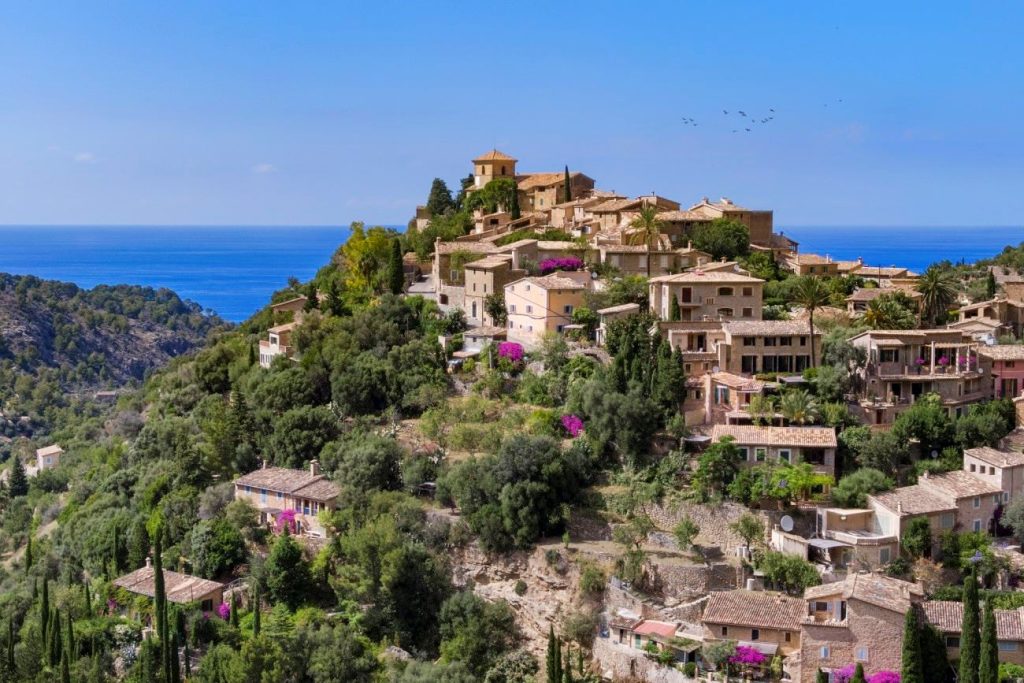
The steep, stone-built centre climbing up to the parish church and cemetery where Robert Graves is buried. Deià is the most sought-after and prestigious pocket of the two villages, prized for its views, its walkability and its concentration of galleries, restaurants and long-established international residents.
Llucalcari
A scattered hamlet on the coast between Deià and Sóller, quieter and more private than the village centre, with a handful of houses reached by narrow lanes and its own small cove below. It suits buyers who want the Deià landscape without the village’s day-trip traffic.
Valldemossa village
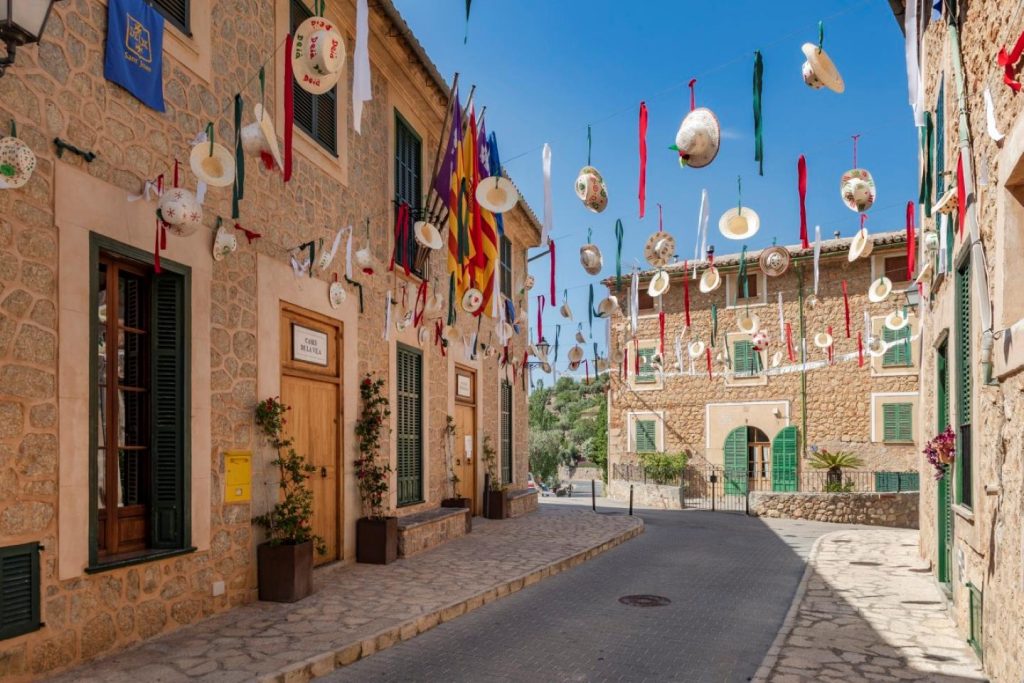
Built around the Real Cartuja monastery where Chopin and George Sand spent the winter of 1838 to 1839, Valldemossa is the more visited of the two villages by day but keeps a genuine year-round population once the coach tours leave in the late afternoon. Good for buyers who want history and services within walking distance.
Miramar and the coast toward S’Estaca
The narrow coastal strip between Valldemossa and Deià, home to Son Marroig, the Archduke’s former estate, and S’Estaca, the historic property associated with Michael Douglas and Catherine Zeta-Jones. Properties here are rare and largely isolated, suited to buyers prioritising privacy and sea views above walking access to either village.
Things to know
Valldemossa in particular sees heavy day-trip traffic in high season, with coach parties visiting the Cartuja monastery from mid-morning to late afternoon; Deià sees less coach traffic but its single main street through the village centre gets genuinely congested on summer weekends. The MA-10 connecting both villages to Sóller and Palma is narrow and winding by nature, not a road built for volume, so journey times can run longer than the distance suggests during peak season. Neither village has a large supermarket, residents typically drive to Sóller or Palma for a full weekly shop.
Holiday-rental licensing (ETV) applies here as elsewhere in the Balearics, restored fincas are popular rental properties, but current rules restrict which building types qualify and how new licences are allocated, so this needs checking property by property rather than assumed. The permanent, year-round population in both villages is genuinely small, well below the summer visitor numbers, which is part of what keeps the pace of life slow outside the day-trip hours.
Who is it for?
- Families: possible, but only with realistic expectations: neither village has an international school, so the choice is the small local Balearic public school in Deià or Valldemossa itself, or a genuine daily commute toward Palma, Bunyola or Santa Maria del Camí for other options. It suits families who want the village and mountain life enough to build schooling around it, not those who need an international school on the doorstep.
- Retirees: a slower, village-centred pace with genuine community and services within walking distance, at the cost of being further from a hospital-scale healthcare centre than the coast.
- Second-home owners: a long-established pattern of foreign ownership going back nearly a century, mostly in restored stone houses and fincas rather than new-build villas.
- Art & culture buyers: the single most literal fit for these two villages, home to Robert Graves’s legacy in Deià and the Chopin and George Sand story in Valldemossa, with a living gallery and studio scene to match.
- Investors: restored fincas let well to visitors drawn by the same landscape and history, but confirm current ETV licence eligibility for the specific property before assuming rental income.
- Cyclists: the Deià-Valldemossa stretch of the MA-10 is part of the Mallorca 312 route and a genuine winter training destination for road cyclists.
Thinking of Buying?
If this mountain lifestyle sounds like the right fit, the next step is seeing what’s actually available across Deià and Valldemossa. Explore the full range of property for sale in Deià or browse Valldemossa listings to get a feel for current stock.
FAQs
Not really, day to day. Each village is walkable in itself, but getting between them, to Sóller, or to Palma for anything beyond basic shopping means driving the MA-10, since public transport along this route is limited and not built around resident routines.
No, not directly in either village. Families typically use the local Balearic public school in Deià or Valldemossa, or commute toward Palma, Bunyola or Santa Maria del Camí for other options, so this is worth planning around before committing to school-age children living here full time.
Both villages have a genuine, if small, year-round population, including families whose roots in the area go back generations, alongside the international residents and second-home owners the villages are known for. It’s a real community, just a compact one.
Both villages sit inside the UNESCO-protected Serra de Tramuntana, and Valldemossa’s historic centre carries additional heritage protections around the Cartuja, so renovation and building work typically needs sign-off from the local ayuntamiento beyond standard planning permission. Anyone considering restoring a finca or historic house here should check the specific rules with the council and a local architect before buying, rather than assuming standard renovation timelines apply.