 Deutsch
 English
 Español

Best Areas to Buy Property in Menorca: A Guide to the Island’s Prime Locations
09 Sep 2026 | By Iris Grünewald
Prime locations and opportunities in Menorca: where to look on the island, what each area actually offers, and why the supply behind them is unlikely to loosen.
Menorca has spent the last three decades doing something most Mediterranean islands have not: staying roughly the same size. Since UNESCO declared the island a Biosphere Reserve on 7 October 1993, growth has been deliberately contained, and that has shaped almost everything about how the island looks, feels and sells today. For buyers used to Mallorca’s density or Ibiza’s nightlife economy, Menorca reads differently: fewer new-builds, more agricultural land left as agricultural land, and a property market where good houses in the right villages simply do not come up that often.
Menorca is not one market, either. It splits, quite cleanly, into an eastern half built around the capital Maó and its natural harbour, and a western half centred on Ciutadella, the island’s former capital and its cultural heart. Between them sit smaller towns, fishing villages and a coastline of coves that rarely gets crowded even in August. Each area has its own character, price level and type of buyer, and the opportunity here is not a cheap purchase. It is constrained supply in an increasingly desirable lifestyle market, which is a different, and arguably more durable, kind of appeal than the “buy now before prices rise” pitch that tends to accompany property guides for this part of the world.
Maó and the Eastern Harbour
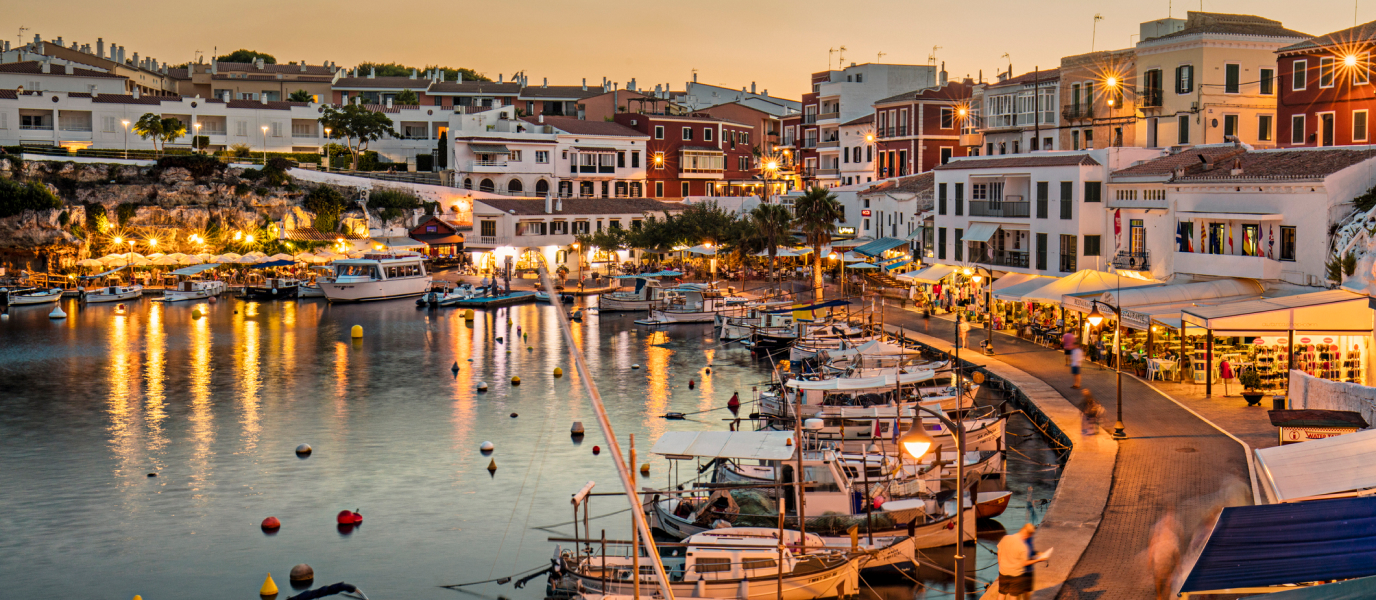
Maó, the island’s capital, sits on one of the longest natural harbours in the Mediterranean, stretching close to five kilometres inland from the open sea. The properties that look down over it, particularly the historic townhouses along the upper town and the quieter stretch toward Cala Llonga, are among the most sought-after on the island. Sailing is part of daily life here rather than a holiday activity, and several harbourside homes come with private moorings, which keeps demand firm among buyers who arrive by boat as often as by plane. Fotocasa’s index put the average asking price across Maó at €3,688 per square metre in August 2026, up 13.4% year-on-year, though that figure covers the whole municipality and sits well below what the harbourfront addresses themselves typically command.
Es Castell and Cales Fonts
A short drive from Maó, Es Castell grew up around a British-built naval garrison and still carries that slightly formal, symmetrical town planning in its streets, a legacy of the decades the Royal Navy spent based here in the eighteenth century. Cales Fonts, its restaurant-lined inlet, has become one of the more polished corners of the island, with houses stepping down toward the water on both sides of the cove. The index put the municipality at €3,535 per square metre in September 2026, up 11.1% year-on-year. Property here tends to sell to buyers who want Maó’s connectivity, the airport, the shops, the marina, without actually living in the capital itself.
Sant Lluís, Binibeca and the Southeast Coast
South of Maó, Sant Lluís and the settlements around it, Binibeca Vell with its cluster of white, cube-shaped houses built to resemble a traditional fishing village, and neighbouring Binissafúller, offer a gentler, more residential version of coastal Menorca. It is also, on paper, the most expensive municipality on the island: the index recorded an average of €4,953 per square metre in August 2026, ahead of Ciutadella and Maó. Fincas with land are common inland, while the coastal pockets favour smaller, low-built villas rather than anything that competes with the skyline.
Fornells and the North
On the northern coast, Fornells keeps its identity as a working fishing village even as it has become one of the island’s more expensive addresses, a claim the data backs up: Es Mercadal, the municipality that includes Fornells, averaged €4,539 per square metre in September 2026 on the same index. The bay is sheltered and popular with sailors, and the surrounding countryside, much of it protected, keeps new construction limited.
Ciutadella and the West
Ciutadella has a different rhythm to Maó. It was the island’s capital until the eighteenth century, and its old town, arcaded streets and cathedral still carry that weight. Property inside the historic centre tends to be townhouses and converted noble houses, while the coast nearby, Cala Morell among the better-known spots, offers newer villas with sea views cut into the cliffs. The index recorded €4,097 per square metre for the municipality in September 2026, up 6.5% year-on-year. Ciutadella also has the stronger day-to-day infrastructure on the western side of the island, which matters for anyone planning to live there year-round rather than for a few summer weeks.
Ferreries and the South Coast
Inland, Ferreries is quieter again, and it works as a base for reaching the beaches around Cala Galdana. At €3,461 per square metre in September 2026, it is the most affordable of the island’s main towns on the index, and one of the areas where traditional Menorcan fincas, working farms until relatively recently, are being converted into family homes with the acreage that has largely disappeared elsewhere on the island.
Alaior, the Interior on the Rise
Alaior does not have a coastline, and conventional wisdom says an inland town should be the value option. The figures do not entirely agree: the index put the municipality at €4,268 per square metre in August 2026, above both Maó and Ferreries. What is happening is less about bargains and more about scarcity finding a new outlet. Alaior has held onto a working town feel that the coastal villages have traded for tourism, and its traditional stone farmhouses, increasingly restored rather than replaced, are commanding prices that rival some coastal addresses precisely because land and character are running short there too.
Where the Areas Compare
| Area | Character | Best for | Typical property | Price level* |
|---|---|---|---|---|
| Maó | Harbour, urban | Year-round living, sailing | Townhouses, apartments | €€ |
| Es Castell | Coastal, formal town planning | Access to Maó without the capital | Houses, villas | €€ |
| Sant Lluís / Binibeca | Residential, southeast coast | Families, second homes | Villas, fincas | €€€€ |
| Fornells / Es Mercadal | Fishing village, north coast | Sailing, summer living | Villas, apartments | €€€€ |
| Ciutadella | Historic, cultural | Year-round living, lifestyle | Townhouses, villas | €€€ |
| Ferreries | Rural, central | Land, access to Cala Galdana | Fincas | €€ |
| Alaior | Interior, working town | Space, authenticity | Fincas, country homes | €€€ |
*Price level based on Fotocasa’s municipal average asking price per square metre, the latest figure available for each town at the time of writing (August or September 2026, depending on when that municipality’s index last updated): €€ up to €3,900/m², €€€ €3,900 to €4,400/m², €€€€ above €4,400/m². These are municipality-wide averages across all property types and mask wide variation between ordinary housing stock and the standout properties this guide focuses on.
What Is Actually Driving the Opportunity
It is tempting to draw a straight line from Menorca’s Biosphere Reserve status to its tight property supply, but the two are not quite the same thing. The 1993 UNESCO designation is a framework and a set of commitments, not a planning law in itself. The document that actually restricts what gets built, and where, is Menorca’s own territorial plan, the Pla Territorial Insular, drawn up and revised by the Consell Insular de Menorca. Its most recent revision, given definitive approval in 2023 and still being refined, caps the island’s maximum tourist beds at roughly 108,000, limits new construction on rural land for the first time, and concentrates growth in areas already zoned for it rather than the coastline or the countryside. The Biosphere Reserve gives that plan its underlying philosophy; the plan itself, not the UNESCO title, is what a buyer’s architect or lawyer will actually have to work within when checking what a plot of land can and cannot become.
Pricing reflects that constraint, though it needs to be read carefully. The figures used throughout this guide come from Fotocasa’s municipal price index, which tracks asking prices in close to real time, useful for spotting trends but not the same as what properties actually sell for. The Balearic association of licensed estate agents (COAPI) closed 2025 with transaction-based figures at historic highs for several Menorcan towns, corroborating the direction of travel even where the exact numbers differ from the portals. Whichever source is used, the pattern is consistent: prices have been rising across the island through 2025 and into 2026, and the towns with the least room to build are generally the ones rising fastest.
Connectivity is part of the story too. Menorca’s airport keeps direct seasonal routes to the UK, mainland Spain and other European countries, which matters more here than on islands where buyers are simply choosing between neighbouring resorts. For many buyers, the appeal is precisely that Menorca has not tried to compete with Mallorca or Ibiza on scale. It has stayed smaller, and that is now much of what people are paying for.
Finding the Right Fit
None of this makes Menorca a bargain destination, and it should not be sold as one. What it offers instead is a market where the constraints are visible and unlikely to loosen, which is a different kind of reassurance for a buyer thinking beyond the next few years. Whether that means a harbour townhouse in Maó, a converted finca near Alaior or a village house in Ciutadella’s old town depends entirely on how the property will be used, and that is worth working out before, rather than after, the search for listings begins.
You can browse current listings across the island on our Menorca properties for sale page, or get in touch with our team for guidance on a specific area.
Continue exploring: compare the Menorca area guide, review the Balearic Islands Buying Guide and understand the main tax considerations for foreign buyers.
Frequently Asked Questions
Which part of Menorca is best to buy property in?
It depends on how the property will be used. Maó and Es Castell suit buyers who want year-round access and a working harbour lifestyle. Ciutadella offers the strongest infrastructure on the western side of the island for full-time living. Fornells and Sant Lluís lean toward summer and sailing-focused buyers, while Ferreries and Alaior suit those prioritising land, privacy and traditional architecture over coastal proximity.
Are property prices in Menorca rising?
Yes. Fotocasa’s index showed year-on-year increases across the island’s main towns through 2026, from 6.5% in Ciutadella to 13.4% in Maó, and the Balearic estate agents’ association (COAPI) closed 2025 at historic highs for several municipalities. The rate of increase varies significantly by town.
Can foreign buyers purchase property in Menorca?
Generally, yes. Foreign buyers can purchase property in Spain, including Menorca, but the exact process, taxes and paperwork depend on the buyer’s residency status and circumstances, so it is worth getting independent legal advice before making an offer.
Is Menorca a good place to invest in property?
Menorca’s market is generally considered less speculative than Mallorca’s, driven more by lifestyle purchases than short-term returns, an assessment shared by market analysts such as Spanish Property Insight. That tends to support price stability rather than sharp swings, but it also means the island rewards buyers thinking in years rather than quarters.
How does buying in Menorca compare with Mallorca?
The two islands are governed by different territorial plans and have grown at very different speeds. Mallorca offers greater scale: more properties on the market, more variety, better year-round connectivity and a larger, more international buyer pool. Menorca is the opposite proposition: smaller, less dense, with a genuinely limited supply of good properties and a lifestyle built around the island staying that way. Neither is objectively better, but they suit different buyers, and it is worth being clear about which one is actually being sought before comparing prices between them.
Related articles

Can we help you?
Call now, send us a message on WhatsApp, or fill out the contact form, and we’ll get back to you as soon as possible.