 Deutsch
 English
 Español


Living in Portocolom
| By Iris Grünewald, Founder & CEO, Balearic Properties
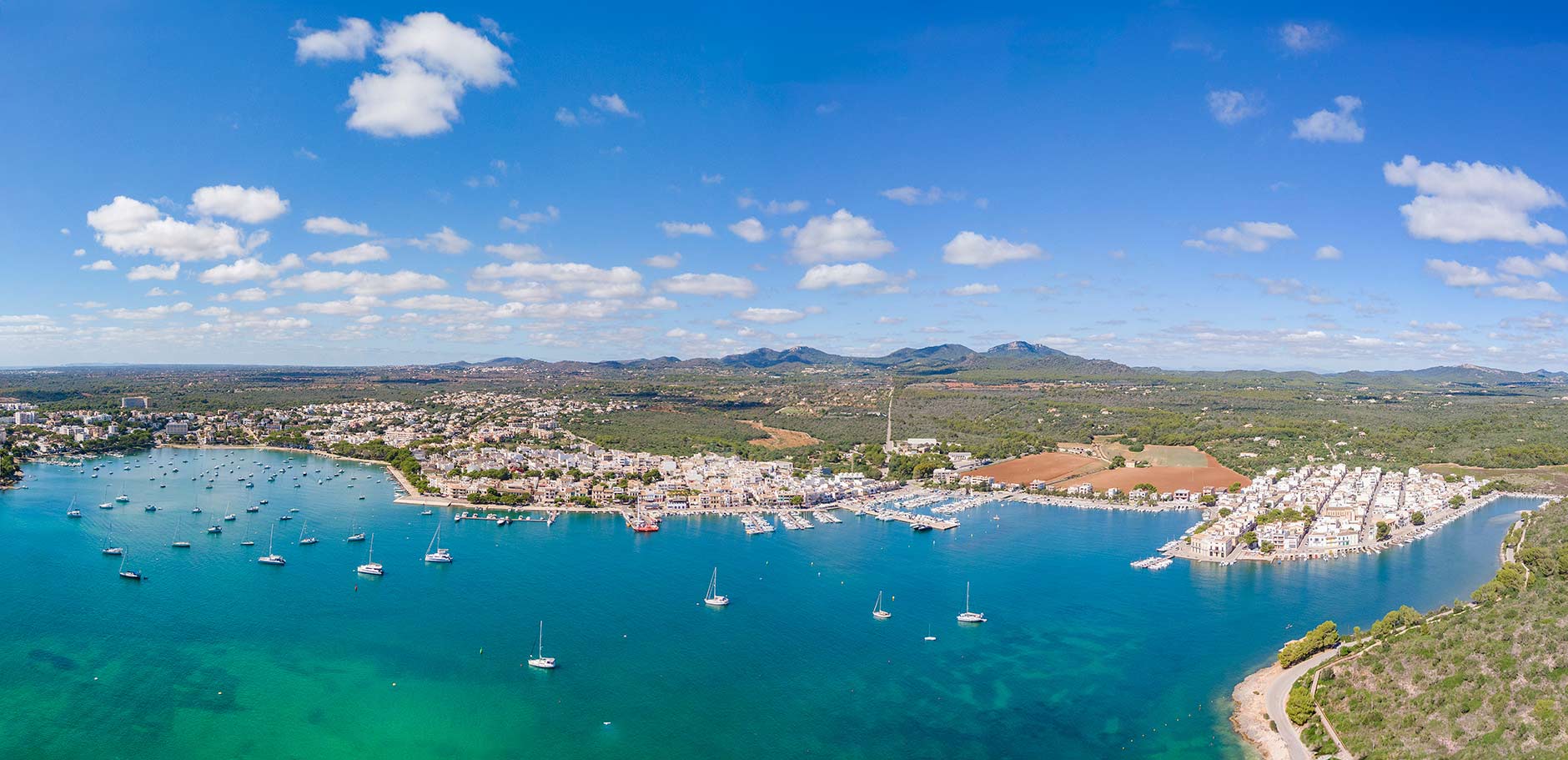
In Portocolom the harbour is more than a backdrop. It is the thread that ties the village’s seafaring past to everyday life today: boats moored beside pastel-coloured houses, a quay where people still gather, and a pace set by the water. It sits on Mallorca’s east coast, in the municipality of Felanitx, and it has never tipped over into resort life.
It is a place best understood through its contrasts. In July the quay fills for the procession of boats on the day of the Mare de Déu del Carme and for an open-air dinner at s’Arenal; outside the season, daily life moves to the village centre, the weekly market and nearby Felanitx. The working harbour, the beaches and the vineyards behind the village all sit within a few kilometres of each other.
Watch: Portocolom on video
A short film of the harbour town itself, “Portocolom, Mallorca | The Mediterranean Lifestyle”.
Portocolom at a glance
- Where
- East coast of Mallorca, municipality of Felanitx
- From Palma Airport
- Around 60 km, a little under an hour by car
- Main beach
- Cala Marçal, Blue Flag in 2026
- Lighthouse
- Punta de ses Crestes, built in 1863
- Markets
- Tuesday and Saturday mornings; Sunday in Felanitx
- Main fiesta
- 16 July, Mare de Déu del Carme, with a procession of boats
A village shaped by the sea
Portocolom is built around one of the few natural harbours on Mallorca, a deep, sheltered inlet that made it the natural outlet for the vineyards and farmland of Felanitx. Its story is written in its buildings and its trade.
In Roman times the sheltered inlet was a refuge for boats, but for centuries pirate raids kept the shore thinly settled, and watchtowers went up from the 14th century. The village took shape in the nineteenth: the customs house opened in 1854, the lighthouse on Punta de ses Crestes, still the symbol of Portocolom, in 1863, and the neo-Gothic church of Mare de Déu del Carme between 1884 and 1887.
Wine tied the port to the countryside. In the late nineteenth century the harvest of Felanitx left through Portocolom, mainly for Sète in France, until phylloxera halted the trade; it resumed in 1947 and 1960. From the 1960s tourism arrived around the bay, yet the village kept its fishing and sailing identity.
A legend worth knowing: local tradition ties the village’s name to Christopher Columbus. There is no historical evidence for it, and most historians place his birth in Genoa. Another explanation traces the name to the Latin Portu Columbi, “port of the doves”, though that also rests on thin sources.
Everyday life around the harbour
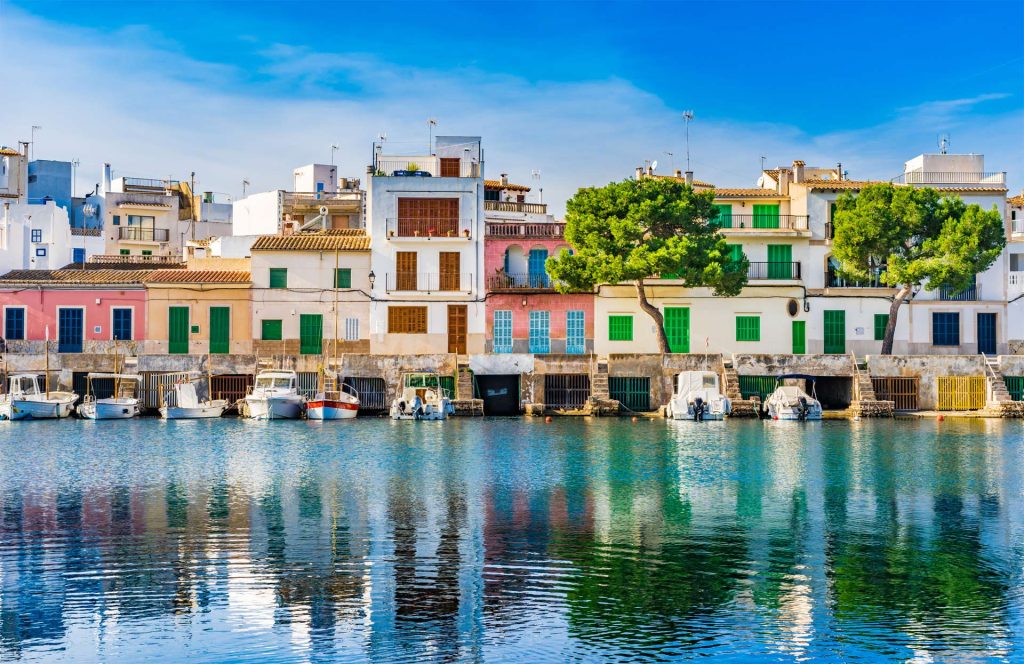
The harbour is more than Portocolom’s defining view. It is the natural point of reference for the village, connecting its maritime heritage with daily life. Houses line the bay, and the quay is where people gather: morning coffee, a lunch of fresh fish, an evening walk as the boats settle for the night. Behind it sit Plaça Sant Jaume, with the church of Mare de Déu del Carme, and the old quarter of Es Riuetó, with its coloured houses and wooden llaüts. The village beach, Arenal dets Ases, is where the summer fiestas gather. Mallorcan Catalan and Spanish are spoken day to day, and German and English are common because of the international community.
Markets set the weekly rhythm. The village market is listed for Tuesday and Saturday mornings, and the larger Sunday market in nearby Felanitx is a regular stop for residents. Market days can change, so confirm them locally. Felanitx is the administrative and cultural centre of the municipality, with Santueri Castle (408 m) and the Sant Salvador sanctuary (509 m, the highest point of the municipality) on its hilltops and a wine-growing countryside around it.
Portocolom on the map
Distances here are short. Tap a pin to read about the place on the map, or choose a card below the map to jump to it.
Map data © OpenStreetMap contributors.
The coast, beyond the beach
The shoreline here is a string of small, distinct places rather than one big beach. Cala Marçal, about 1 to 1.7 km from the village, is the main one: roughly 150 m of sand with calm water and a gradual entry, Blue Flag in 2026, listed as accessible, with lifeguard, loungers and restaurants in season. Cala Brafi is a tiny cove of about 40 × 20 m with no facilities, around 2.5 km from the village. Cala Sa Nau also flew a Blue Flag in 2026, and Mondragó Natural Park, 766 hectares protected since 1992, is a short drive south.
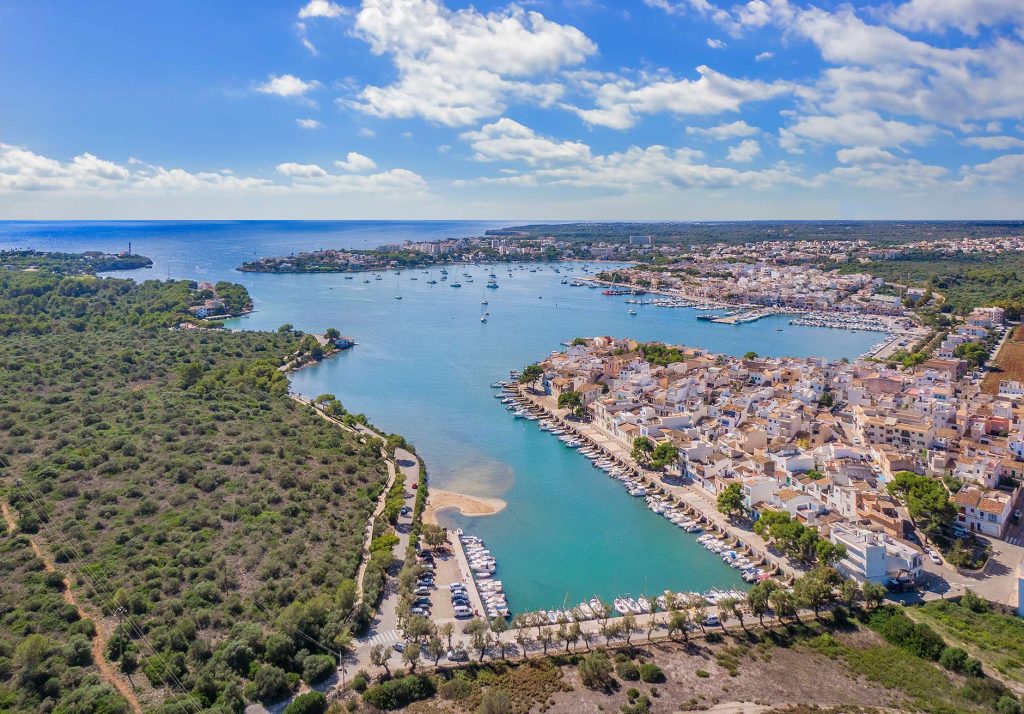
On foot, a coastal route of around 4.5 km, easy going, leads out to the Punta de ses Crestes lighthouse. It is still in service, so you cannot get close; for a photograph, the opposite side of the bay at Cova Foradada works well. On the way, the Baños de Cleo are natural pools between s’Arenal and the lighthouse, reached by a path with steps and metal ladders, so wear sturdy shoes. On the water, Club Nàutic Portocolom is the village’s sailing club, and Vall d’Or Golf, an 18-hole, par 71 course opened in 1986, is within reach.
A taste of local life
As a former fishing port, Portocolom is known for seafood and rice dishes, and the cafés and restaurants along the quay cater to residents as much as visitors. A few places named in local guides, not a ranking; opening times change with the season, so check before you go.
- Restaurante Colón chef-led cooking in a long-established harbour address, run by Dieter Sögner.
- Florian a harbourfront classic, open for more than 20 years.
- Vora Mar rice dishes and fish paella, which suit the village’s seafood identity.
- Sa Cova Dets Ases pa amb oli breakfasts on the church square, where village life passes by.
The local calendar adds the rest. The Fira Gastronòmica d’es Pop, at the end of June, builds menus around octopus; the Raïm Wine Fest at Sa Bassa Nova celebrates local wine in July; and the festivities around 16 and 25 July, with the boat procession and the sopar a penyes at s’Arenal, are the village at its most communal.
Portocolom through the seasons
Portocolom is not the same place all year round. In summer the quay is at its liveliest, and the population is often said to double. Beach services and lifeguards at Cala Marçal run in season, and the fiestas begin in July, with the procession of boats on 16 July and the sopar a penyes at s’Arenal. Outside the season the village slows down: daily life moves to the centre, the weekly market and nearby Felanitx, while the harbour and its traditional boats remain at its heart.
Portocolom had 4,613 inhabitants in 2020 (INE), about a quarter of the municipality of Felanitx (18,850 in 2024). A free summer bus linking Cala Marçal and s’Arenal was piloted in 2026. Some seasonal businesses close in winter, and which restaurants and shops stay open all year varies, so ask locally. It is worth seeing both versions before deciding how to use a home here.
| April | Triathlon Portocolom (formerly TriStar Mallorca) |
| Last weekend of June | Fira Gastronòmica d’es Pop |
| July | Raïm Wine Fest at Sa Bassa Nova |
| 16 July | Mare de Déu del Carme: mass, procession of boats with the image of the Virgin, and a night fair on Plaça Sant Jaume |
| 25 July | Festa de Sant Jaume, with correfoc and fireworks, and the sopar a penyes on the Friday closest to it |
| 15 August | Festa de l’Assumpta |
| 28 August | Sant Agustí in Felanitx, with the Cavallets |
| October | Fira del Pebre Bord in Felanitx, on the Sunday after 18 October |
Dates follow the Ajuntament de Felanitx programme and the Mallorca tourism calendar. Check them each year.
Different sides of Portocolom
Portocolom is compact, so its sides are more about atmosphere than distance.
The harbour front. Life organised around the quay: cafés, the market and the church square, with most things within a walk.
Cala Marçal. Built up around the beach, with its own services and a lighter, more resort-like feel in season, and calmer outside it.
The lighthouse side of the bay. Quieter and more residential, with views back across the harbour and the coastal path towards the lighthouse and the Baños de Cleo.
The countryside around Felanitx. Vineyards, olive and almond land and country fincas a short drive from the harbour, under the hill of Sant Salvador.
The practical side of living here
Getting around
Portocolom is easy to enjoy on foot, but the wider southeast is a car-based area, and most residents drive for shopping, healthcare and weekend trips. Renting a car at Palma Airport is the simplest way to explore.
| Felanitx | around 12 km |
| Manacor | around 22 km |
| Palma Airport | around 60 km, a little under an hour |
| Palma city centre | around 62 to 65 km |
From Palma, bus line 501 runs to Felanitx and line 512 continues to Portocolom; since February 2025 there has been a direct early-morning service to Palma on weekdays. Line 428 (Cala d’Or to Porto Cristo) calls at Portocolom, and Taxi Portocolom has ranks at the quay and on Avinguda Cala Marçal. Check the current TIB timetable before relying on any service.
Schools and healthcare
CEIP S’Algar, the public primary school, is in Portocolom. Secondary school and Bachillerato are at IES Felanitx, and school transport has run from the village. For international options, Rafa Nadal International School is in Manacor (about 20 minutes) and Tudor Rose British College is in Porto Cristo. The local medical centre (consultori) is on Carrer del Vell Marí and depends on the Felanitx health centre; there is a pharmacy in the village. The hospital in Manacor is about 30 minutes by car and Son Espases, in Palma, about an hour.
Everyday services and life beyond the summer
Shops and supermarkets, a library, a sports hall and a tourist office serve the village, and Felanitx covers the rest of everyday needs. Outside the season, expect fewer open businesses and a smaller bus offer, so it is worth visiting in winter before deciding how you would use a home here.
A different pace of Mediterranean life
Portocolom is not defined by a single beach or sight. It is the relationship between the harbour, the village and the countryside behind it, and the way that relationship changes between the procession of boats in July and a quiet morning outside the season. For those drawn to a more understated corner of Mallorca, that is what makes it worth getting to know.
Properties
Homes in Portocolom and Felanitx
If the village appeals to you, see what is on the market in Portocolom and across the surrounding Felanitx area.
Explore propertiesDiscover more of Mallorca: Southeast Mallorca area guide · all Mallorca area guides · price comparisons
FAQs
Where is Portocolom?
Portocolom is on the east coast of Mallorca, in the municipality of Felanitx. It is built around one of the few natural harbours on the island and is about 60 km from Palma Airport by road.
Is Portocolom a good place to live all year?
Yes. It is a working harbour village rather than a purpose-built resort, with a village centre, a weekly market, a primary school, a local medical centre and the larger town of Felanitx a short drive away. Beach-side areas are quieter outside the summer season and some seasonal businesses close, so choose the location according to how you plan to use the home.
What is Portocolom like in winter?
Quieter. Daily life shifts to the village centre, the weekly market and Felanitx, while beach-side areas are calmer. Which restaurants and shops stay open varies, so ask locally.
Can you get around Portocolom without a car?
The village itself is walkable, and bus line 512 connects it with Felanitx, where line 501 runs to Palma. The wider southeast is a car-based area, and renting a car at Palma Airport is the simplest way to explore.
Are there schools and healthcare in Portocolom?
The public primary school CEIP S’Algar and a local medical centre are in the village. Secondary education is at IES Felanitx, international schools are in Manacor and Porto Cristo, and the nearest hospital is in Manacor, about 30 minutes by car.
Which is the main beach in Portocolom?
Cala Marçal, about 1 to 1.7 km from the village. It has sand, calm water, a Blue Flag in 2026, lifeguard service in season and good accessibility. Quieter options include Cala Brafi and the coves towards Cala Sa Nau.
What are the main fiestas in Portocolom?
The Mare de Déu del Carme on 16 July, with a procession of boats, and the Festa de Sant Jaume on 25 July, with the sopar a penyes at s’Arenal. The Festa de l’Assumpta follows on 15 August.
Where can I watch a video of Portocolom?
Our film “Portocolom, Mallorca | The Mediterranean Lifestyle” is embedded near the top of this guide and is also available on YouTube at https://www.youtube.com/watch?v=qP1SH4m95YI.
Related articles
Can we help you?
Call now, send us a message on WhatsApp, or fill out the contact form, and we’ll get back to you as soon as possible.